
How AI Picks Which Accounting Firms to Cite

The complete playbook, including the off-site work most guides leave out.
A nonprofit director in St. Louis needs an accountant. She doesn't open Google. She opens ChatGPT and types the way she'd talk to a colleague: "We're a $2M nonprofit and our books are a mess before the audit. Who specializes in nonprofit accounting and what should I ask them?"
She gets an answer. Three or four firms are named in it. She picks one and books a call.
Every other firm in the country was invisible for that question. Not ranked low. Absent. There's no page two, no impressions report, no way to find out you were considered and passed over. You simply never hear about it.
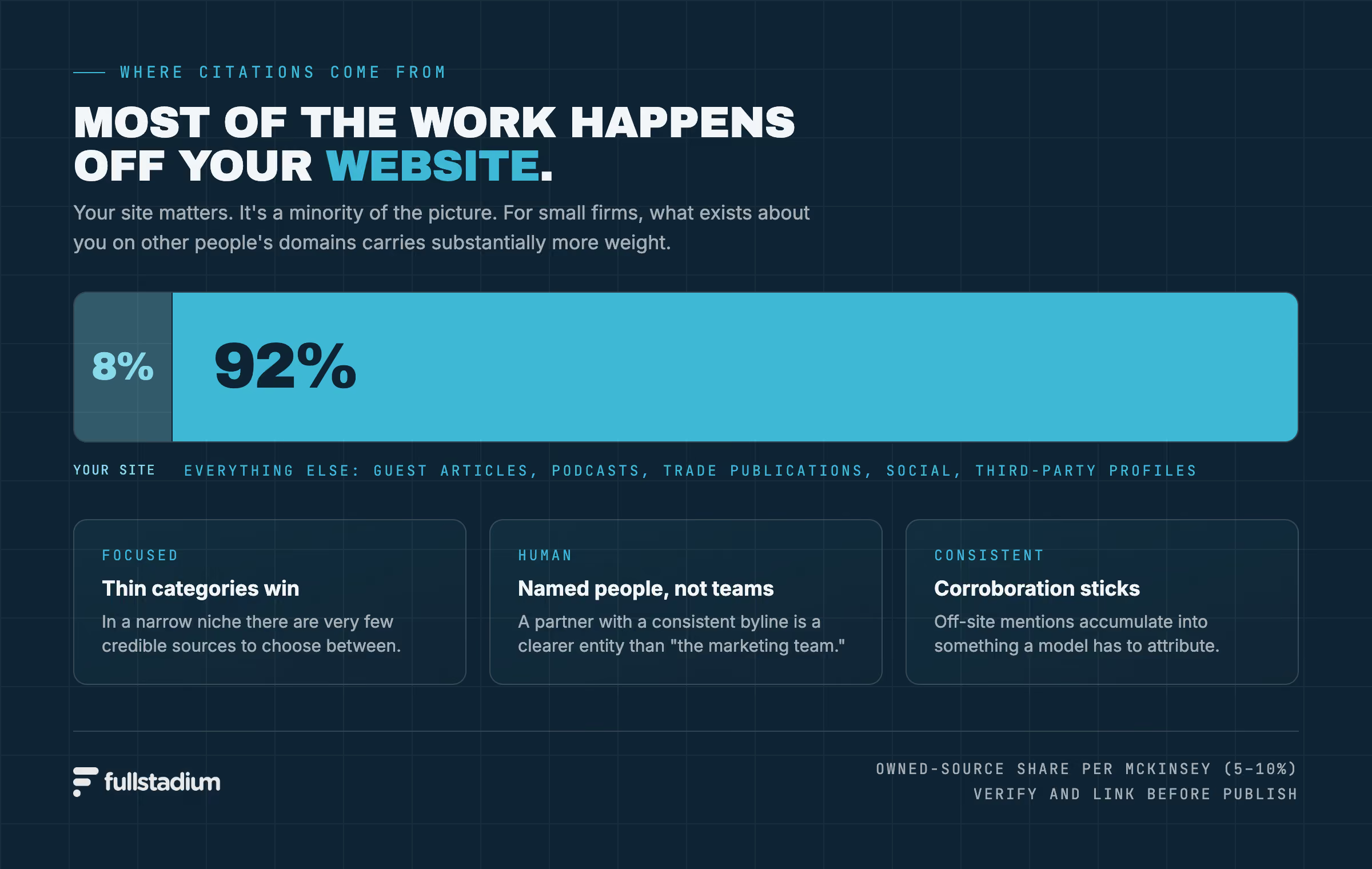
Answer engine optimization is the work of getting named in that answer. Most of the advice you'll find about it is website advice: tighten your service pages, clean up your About section, add schema markup. That advice isn't wrong. It's aimed at roughly ten percent of the job.
This guide covers the other ninety.
This guide explains the mechanism: how AI systems decide which firms to name, and what influences it. If you'd rather skip the explanation and talk about having this done for your firm, that's what we do.
Why small firms have the structural advantage
There are two ways an AI tool can produce your firm's name, and the difference between them decides your entire strategy.
The first is memory. These models are trained on an enormous frozen snapshot of the internet. A Big Four firm appears in that snapshot thousands of times over. Your eleven-person firm does not appear in it in any meaningful way. Neither does your niche.
The second is retrieval. When the model has nothing useful in memory, it runs a live search at the moment of the question, reads the pages that come back, and writes its answer out of them. Snapshots also carry a cutoff date, so anything recent, local, or highly specific has to be fetched. Semrush's analysis of ChatGPT clickstream data describes the split directly: questions the model can answer from what it already knows get answered from memory, and questions it can't trigger a search.
Because your firm was never in the snapshot, essentially all of your AI visibility runs through retrieval.
Most firm owners hear that and feel invisible. It's the opposite. Being in the training data means being stuck with whatever the model learned, waiting a year or more for a retraining run to change it. Retrieval carries no such lag. The answer is rebuilt from what exists on the web this week. Change what exists and the answer can change within months.
There's a second mechanic underneath that one, and it's the reason a small firm should bother at all. Retrieval is not citation. An AirOps study of more than 548,000 pages across 15,000 prompts found ChatGPT cites only about fifteen percent of the pages it pulls in. The rest are evaluated and discarded. Retrieval is the audition. Citation is the part.
The encouraging finding sits in the same research. Once a page has been retrieved, mid-authority domains get cited at rates comparable to much larger ones. At the selection stage the model isn't filtering for size. It's filtering for whether the page answers the question with something specific enough to quote.
That's a fight a small specialist firm can win. Which brings us to the first principle.
Focused: pick a category you can win
In AI search, focus isn't a positioning preference. It's arithmetic.
Ask a model about "small business accounting" and it's choosing among thousands of plausible sources. Ask it about accounting for medical aesthetics practices and the field collapses to a handful. The narrower the category, the fewer sources exist for the model to choose from, and the more likely one of the survivors is you.
This is where most firms stall, so make the decision explicit. There are two viable shapes.
Local generalist. You compete on geographic modifiers, like "best CPA in Lafayette for small business." Your citation set is chambers of commerce, regional business journals, local associations, and a well-maintained Google Business Profile. Lower ceiling, faster to establish.
National niche. You compete on industry modifiers, like "accountant for med spas" or "nonprofit CFO services." Your citation set is trade press, industry conferences, niche podcasts, and association directories. Higher ceiling, but it requires genuine domain depth you can't fake.
Pick one. A firm pursuing both produces a source profile too diffuse for a model to categorize, which is the one outcome worse than being narrow.
There's a wrinkle here that most AEO methodology misses. The standard approach starts with competitor gap analysis: find who's ranking, reverse-engineer what they've published, do it better. In genuinely thin categories that breaks down, because there often aren't competitors to reverse-engineer. Search for authoritative content on med spa inventory accounting and you'll find very little.
That isn't a problem. It's the opportunity. But it means the raw material has to come from somewhere other than competitive research. It has to come from the firm owner's own expertise, extracted rather than found. We'll come back to that.
If you're still deciding whether to commit to a niche at all, that's a strategy question, and it's covered in The Complete Guide to Accounting Firm Marketing.
What focus produces: Liguori Accounting
Nick Liguori started his New Hampshire firm in 2020 with modest ambitions. Two years in, a referral brought him a local med spa. That client led to another, then several more.
Two years ago the firm made the uncomfortable decision to serve med spas exclusively. As Nick described it to Rachel Dillon on the Who's Really the Boss? podcast, covered by Earmark, it meant letting go of clients who no longer fit. Today the firm has seven employees and just under $1 million in revenue, with packages running from $800 to $2,000+ per month and onboarding fees of $3,000 to $5,000. Onboarding time dropped from sixty days to thirty. The firm now caps new clients at two per month.
The marketing lesson is in one line from that interview. What worked was getting into the industry spaces where med spa owners were already gathering. Conferences. Industry podcasts. Webinars for med spa operators. The New Hampshire med spa association, joined early, when the cost of entry was low.
Notice that none of those are accounting venues. He isn't building authority in front of accountants. He's building it in front of his clients' industry.
Now look at what that produced. When someone asks an AI about accounting for med spas, one of the strongest pages available to cite is that Earmark article. A page Nick didn't write, doesn't own, and can't edit. It carries more weight than anything on his own website could, precisely because he didn't publish it.
That's the ninety-ten rule demonstrated rather than argued.
Human: be the source, not the summary
Models are extraordinary at synthesizing what already exists and completely incapable of producing what doesn't. Anything that can only come from you is, by definition, something a model has to cite rather than generate.
In ascending order of value:
- Patterns across your client base. "In eight of the last ten med spa P&Ls I've reviewed, equipment was buried in the wrong place on the balance sheet." No model can produce that sentence. It has to find someone who's seen the P&Ls.
- Named positions on contested questions. Where you disagree with the conventional advice in your niche, and why.
- Original data. A survey of your clients. Numbers from your own book of business. Anything with a figure attached that didn't exist before you published it.
Here's the operational problem. Most firm owners have all of this and can't get it out. Sit them down to write and they produce something that sounds like every other firm's blog. The expertise is real. The writing interface is the bottleneck.
The fix is an interview. Thirty minutes of someone asking good questions produces material that hours of staring at a blank page won't. It's the same reason journalists interview experts instead of asking them to submit essays. Take the interviewer out in the edit and what's left is the practitioner's voice, saying things only they could say.
Worth being direct about something firm owners consistently underestimate here. Accounting has a reputation for being dull, and a lot of accountants have absorbed that reputation about their own work. Their clients haven't. We put together a case study recently for a firm whose client was selling one business and buying another at the same time, and the trust that transition required determined the financial future of a family. The gratitude in that interview had nothing to do with the accuracy of a return.
That's what the raw material looks like. It's sitting in your practice right now, and the only reason it isn't published is that nobody captured it while it was specific. More on that here.
Showing your face: Mire Group CPAs
Mire Group CPAs in Lafayette, Louisiana publishes articles that answer the questions their clients ask. What year-round tax advisory means in practice, how quarterly estimated taxes work, whether real estate losses can offset W-2 income.
The structural choice worth copying: each article carries a short video of Marcus Mire explaining the same concept on camera. The written piece is what a model extracts from. The video is what a human trusts. One recording session produces both, plus a podcast episode and several social clips.
That's the compounding property to design for. A single conversation becomes a blog post, a YouTube video, a newsletter issue, and a handful of posts. Four or five retrievable artifacts on different surfaces, from one hour of the owner's time. The full production method is in Content Marketing for Accounting Firms.
One detail matters more than it looks. Publish under a person's name, with credentials, not a firm byline or a generic marketing account. Individual voices carry weight that organizational ones don't, and "Marcus Mire, CPA" is a stronger signal than the firm name alone. The same logic applies on social platforms, where a personal profile outperforms a company page for reasons that are no longer only about reach. More on that here.
On the on-site mechanics, meaning answer-first paragraphs, question-shaped headers, and clean structure a model can lift a sentence from, Ryan Lazanis has written a solid practical guide to AEO for accountants that covers the website checklist thoroughly. Use it. Then spend the rest of your effort on everything that isn't your website.
Consistent: authority accumulates over time
A single placement moves nothing. What moves the needle is a body of published work that keeps getting retrieved, with corroboration accumulating across domains you don't control.
The mechanism is straightforward. A firm cited on six independent domains over two years reads as established. The same firm with one placement reads as noise. A page on your own site claiming you're the leading advisor to nonprofits is a self-assertion. An article somewhere else demonstrating it is corroboration, and corroboration is harder to manufacture, which is exactly why models weight it more heavily.
Muck Rack's analysis of more than 25 million links found earned third-party media accounts for roughly 84% of AI citations, holding between 82 and 89 percent across three editions of the study. Other researchers land on different splits depending on what they count as third-party, so treat the exact figure as unsettled. The direction isn't.
This is the pillar most firms fail. Not because it's difficult, but because it's slow and unglamorous and produces nothing measurable in the first quarter.
There's a second reason it fails in this profession specifically, and it's worth naming. Busy season is always around the corner. A firm builds real momentum through the fall, then January arrives and everything stops until late April. Do that twice and the accumulation never happens, because you spend every other quarter rebuilding what lapsed. Corroboration compounds only if it keeps arriving. The firms that win here aren't the ones producing the best work. They're the ones still publishing in February.
That's a design problem, not a discipline problem. Front-load the input in the fall, batch the production, and build something that doesn't need a partner's attention during the months when a partner has none to give.
What compounding looks like: The Charity CFO
The Charity CFO serves nonprofits exclusively. Founder Tosha Anderson spent years working inside a nonprofit before starting the firm, and the whole operation is built around publishing into that world.
She hosts A Modern Nonprofit, past a hundred episodes and still weekly. The firm runs a YouTube channel, a blog, a newsletter, and active social accounts. That's the owned layer, and it's substantial.
The layer that matters more is the one she doesn't own. Tosha appears on other people's podcasts, including John Garrett's show, Successful Nonprofits, and local nonprofit media. Her hosts write up their episodes on their own sites and link back. Third parties describe her independently as a nationally recognized voice in nonprofit finance.
That's the signal profile that gets a firm named: a decade of consistent publishing on her own channels, wrapped in years of corroboration from domains she has no control over. No single piece of it did the work. All of it together is why, when someone asks an AI about nonprofit accounting, there's a well-established answer.
Neither of these outcomes happened in a quarter. Both took years.
The accounting citation set
Most AEO advice is written for software companies, and it leans heavily on review platforms. Get on G2, get on Capterra, get on Trustpilot. For niche accounting queries, that lever effectively doesn't exist. There's no G2 for nonprofit CFO services.
That's good news for firms with real expertise, because it means this profession's citation set is editorial. It's earned through demonstrated knowledge rather than gamed through profile completeness. Roughly in order of weight:
- Profession press. The Woodard Report, Earmark, CPA Practice Advisor, Accounting Today. Most accept contributed articles.
- Your clients' industry press. The most underused surface in accounting marketing. Med spa trade publications, nonprofit sector media, construction industry outlets. Far less competition than accounting press, and far closer to the buyer.
- Podcasts with published show notes and transcripts. Both your own and, more importantly, other people's.
- Association and conference speaker pages. Thin, unglamorous, reliably retrieved, and usually free.
- LinkedIn, under an individual profile. Not the company page.
- Google Business Profile and structured directories. The floor. Necessary, not sufficient.
The through-line: every one of these requires either publishing or a relationship. None of them is technical.
Which is worth sitting with, because this is the same work that has always produced referrals. When a client tells another business owner about you, that's word of mouth, and it's the highest compliment in professional services. What's changed is that a version of it is now legible to a machine. Getting your expertise published where your industry can see it is word of mouth on steroids: the same message, the same borrowed credibility, reaching people who don't happen to know your clients personally. More on how that fits a lead generation plan.
Measure it
Almost no accounting firm is measuring this, which makes it a cheap advantage.
Write down five to ten prompts a real prospect would use. Full questions, not keywords. Run them in ChatGPT, Perplexity, Gemini, and Google's AI results. Record two things: which firms get named, and which domains get cited. That second list is your target list.
Re-run the identical prompts every ninety days. Same wording, same tools. The comparison is your measurement.
Neither Google Search Console nor GA4 can show you this. They report on traffic that arrives, and the whole problem with AI answers is the traffic that never does. For ongoing tracking across platforms, purpose-built tools like Rankability monitor citation presence over time.
Where to start
Go back to that nonprofit director in St. Louis. The firms named in her answer aren't the biggest. They're the ones whose expertise had been published somewhere a model could find it, consistently enough and long enough that a pattern formed.
Focus so the category is winnable. Be human so there's something worth citing. Be consistent so it compounds. Then spend most of your effort off your own website, because that's where the citations live.
Nick Liguori, Mire Group CPAs, and The Charity CFO are Full Stadium clients. Their results reflect the full range of what each firm does, including referrals, conferences, associations, and relationships built over years, not marketing alone.
If you want to talk through where your firm shows up today and what's reachable from here, that's what the strategy meeting is for.

Micky Deming shares insights on marketing, growth, and storytelling for accounting firms. Explore his expertise and practical strategies on the Full Stadium blog.
Related posts

Complete Guide to Accounting Firm Marketing
Content Marketing for Accounting Firms
Client Stories as Proof
Lead Generation for Accounting Firms
Social Media Marketing for Accounting Firms

How We Use AI for SEO for Accountants