
Content Marketing for Accounting Firms


Content Marketing for Accounting Firms: How to Publish Without Becoming a Writer
Short answer: Content marketing works for accounting firms when it's built from what you already know instead of what a writer guesses you know. The firms that win aren't publishing the most. They're publishing something only they could have said, and doing it long enough that it compounds.
Most accounting firms fail at content marketing for the same reason. Not lack of expertise. Not lack of budget. They fail because the process asks a partner who bills $400 an hour to sit down and write a blog post, and that never survives busy season.
So the firm hires a writer. The writer doesn't know what a 754 election is, or why a med spa's revenue recognition differs from a restaurant's, or what keeps a nonprofit executive director awake in October. What comes back is technically correct and completely generic. The kind of article that could have been published by any of the other 46,000 accounting firms in the country.
That used to be a waste of money. It's now a liability, and I'll get to why.
The three things that make content work
I've narrowed it to three. Same framework whether I'm talking to a firm owner, a room at Earmark, or readers of The Woodard Report.
Focused. Pick a category you can win. Human. Be the source, not the summary. Consistent. Build something that keeps rolling through busy season.
Everything below is those three, applied.
Focused: stop writing for everyone
The most common content mistake I see at accounting firms is breadth. A blog with 60 posts covering tax deadlines, QuickBooks tips, retirement planning, entity selection, and year-end checklists. Each one competing against a thousand better-resourced publishers, and none of them signaling what this firm is for.
Compare that to a firm that publishes only about the financial realities of running a med spa. Fewer posts, narrower audience, far better outcome.
The obvious reason: a med spa owner reading that content knows immediately they've found the right firm.
The less obvious one: in a narrow category, there are very few credible sources. When someone goes looking for an expert on med spa financial operations, the competition is thin. In a broad category you're one voice in a stadium. In a narrow one you might be the only person who has said anything specific at all.
How to pick the category. Look at your client list and find the concentration you already have. Most firms have one. Three restaurant groups, or a handful of dental practices, or four nonprofits, usually acquired by referral without anyone deciding it was a niche. That's your category. You have the domain knowledge and the war stories.
If you're weighing whether to commit to a niche at all, that's a strategy question, and I've covered it at length in the complete guide.
Human: your work matters more than you think
Accounting has a reputation for being boring. To your clients it's anything but.
We put together a case study recently for a firm that walked a client through selling one business and buying another. The due diligence involved was enormous. So was the reliability required, and the trust. That transition determined the financial future of a family, and the accountant was a partner through every step of it.
The gratitude that client expressed had nothing to do with compliance work. It was about having someone in their corner during the biggest decision they'd ever made.
Don't sell yourself short. Business owners care deeply about what they've built. They take pride in it. Most of them are hungry for a relationship with someone they can trust to help them reach their goals. Your marketing should reflect that. Show some personality. Tell your success stories. Share the industry insights that give your clients an edge.
What can't be manufactured
The marginal cost of producing a competent, generic article is now roughly zero. Anyone can generate 1,200 words on "5 Tax Tips for Small Business Owners" in about eleven seconds. Which means the value of that article is also roughly zero.
What hasn't been commoditized is the thing that happened in your office last Tuesday. The client who came in convinced they needed an S-corp election and left understanding why it would have cost them money. The nonprofit that failed an audit because of how they'd been booking restricted funds for six years. The specific, hard-won thing you know because you did the work.
That material can't be generated. It can only be reported.
The interview method
This is the part of our model I'd defend hardest, because it solves the actual bottleneck.
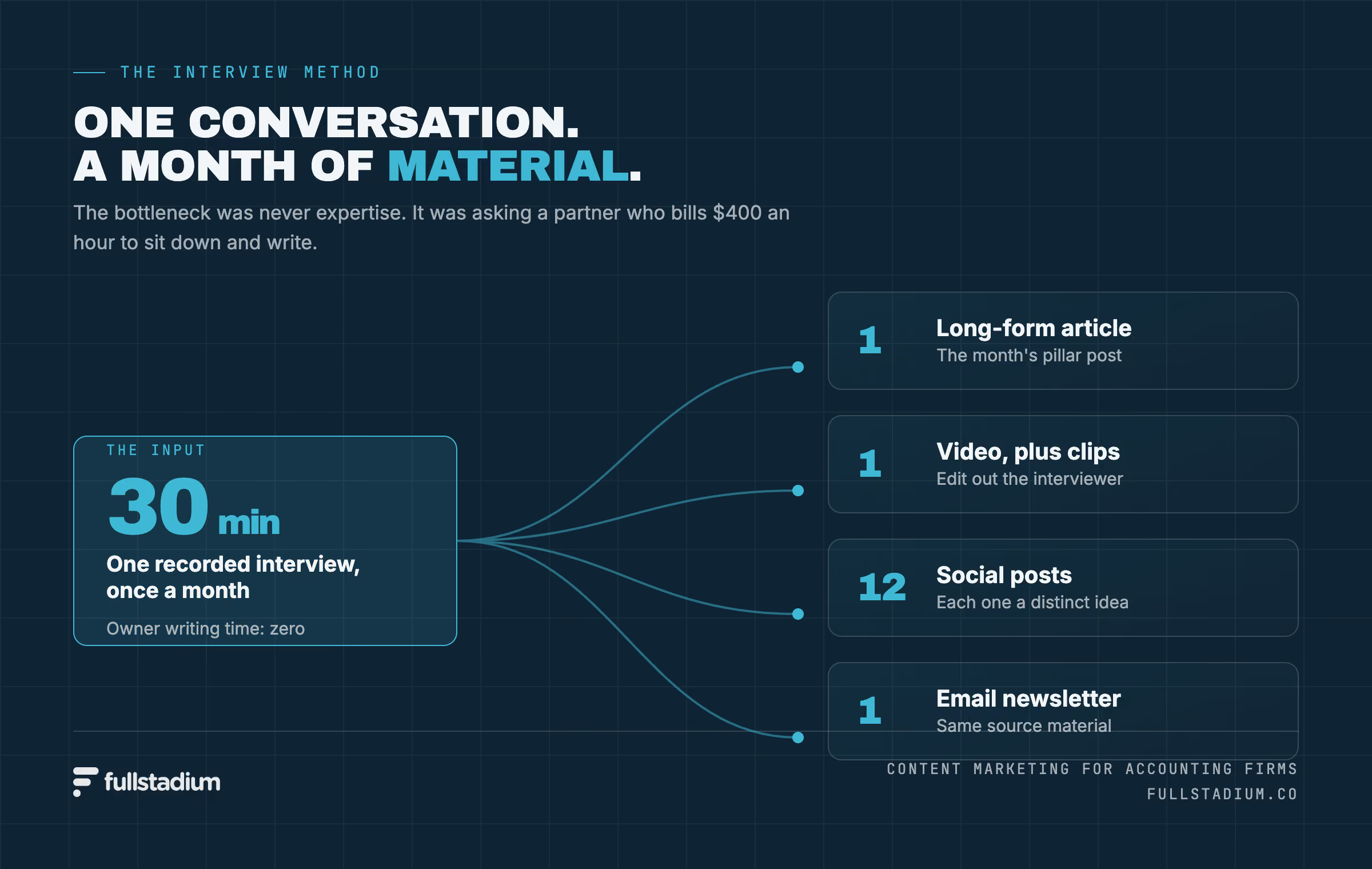
I have a journalism background. So instead of asking clients to write, which they won't, or briefing a writer who doesn't know the domain, I interview firm owners the way a reporter would. Thirty minutes, once a month, recorded. I ask questions, they answer, and I get out of the way.
That single conversation becomes the month's blog post, the social content, the email, and the video. Total client writing time: zero. Total client time: under two hours.
The output sounds like a person because a person said it. Every claim traces back to something on the recording.
If you're doing this yourself, the method transfers. Record yourself answering a client's question out loud instead of trying to write the answer. Talk for ten minutes and transcribe it. The structure will be rough and the prose will need work, but the substance will include things you'd never have typed. The aside, the example, the "well, it depends, and here's what it depends on." That's the material worth publishing.
What to ask. The best questions aren't about topics, they're about moments:
- What's a mistake you see constantly in this industry?
- What did a client believe that turned out to be expensive?
- What's changed in the last two years that most firms haven't adjusted to?
- Walk me through a specific engagement. What surprised you?
- What do you wish clients asked before signing?
Consistent: building something that survives busy season
Content marketing has a brutal shape. Nothing happens for months, then it compounds faster than seems reasonable.
You're not building a flow, you're building a stock. Each piece stays live, keeps accumulating links and mentions, and keeps being available to be found. The firm that has published monthly for three years isn't three times better off than the firm that published for one. The gap is much wider, because the early work has had time to be discovered, cited, and referenced.
Which is why cadence beats volume. Two good posts a month sustained for two years will beat twelve mediocre posts a month sustained for four.
The seasonality problem
Here's the part specific to accounting firms, and it's the reason most firm marketing dies.
Busy season is always around the corner. You start something in September, build real momentum through the fall, and then January arrives and everything stops. By the time you surface in late April, the habit is gone, the rankings have slipped, and you're starting over. Do that twice and you've concluded content marketing doesn't work, when what didn't work was the stop-start.
The firms that win aren't the ones with the best content. They're the ones whose marketing keeps rolling in February.
That's a design problem, not a discipline problem. It means front-loading the input while you have capacity, batching production, and building a system that doesn't require a partner's attention during the months when a partner has none to give. One recorded conversation in November can carry January and February. The work gets done when there's room for it.
If you're planning a cadence, pick the one you can hold through April. If that's one post a month, publish one post a month.
What this has to do with AI
I said generic content is a liability now, not just a waste. Here's the reason.
A growing share of your prospects will never see a list of search results. They'll ask ChatGPT or Perplexity or Google's AI mode who they should hire, and get back a short answer naming two or three firms. Whether you're in that answer depends on whether the model has anything specific to attach to your name.
Generic content gives it nothing. If your article says the same thing as forty others, the model summarizes the consensus and cites nobody, or cites whoever has the most authority, which won't be you.
Specific content gives it something to grab. An original argument, a named practitioner, a story with details in it. Those are things a model has to attribute rather than absorb.
And most of that work doesn't happen on your website. For small firms, off-site material like guest articles, podcast appearances, and trade publication features carries substantially more weight than anything on your own domain. One of my clients has an article about him on a third-party accounting site that outperforms his entire website in AI results. He didn't write it and doesn't own it.
I've broken down the mechanism in How AI Picks Which Accounting Firms to Cite. That's what I'd read next if any of this is new.
A publishing checklist that matters
Format isn't strategy, but a few structural things affect whether your work gets found and cited:
- Put a real name on it. Not "Marketing Team." A named author with a real bio page is a credibility signal for humans and machines alike.
- Answer the question in the first paragraph, then elaborate. Don't build to a conclusion.
- Use headings that match how people ask. "How much should an accounting firm spend on marketing?" beats "Budget Considerations."
- Keep URLs clean and undated. A date in the URL makes current work look stale. We had this problem ourselves for years.
- Link to your own related work deliberately, where it genuinely helps.
- Publish where your audience already is. A piece in a trade publication your prospects read is worth several on your own blog.
Where to start
If you take one thing from this: your content should be a record of what you know, not a summary of what's already published.
That's harder than it sounds, and it's the only durable advantage available to a firm your size. You can't outspend the national players. You can out-specific them.
If you want to talk through what this would look like for your firm, that's what the strategy meeting is for.

Micky Deming shares insights on marketing, growth, and storytelling for accounting firms. Explore his expertise and practical strategies on the Full Stadium blog.
Frequently asked questions
Once or twice a month, held consistently, outperforms any higher cadence you can't sustain through busy season. Consistency compounds. Volume doesn't.
For research, outlining, and editing, it's useful. For generating the substance, it defeats the purpose. The entire value of your content is that it contains things only you know, and AI can't report what happened in your office.
Six to twelve months before meaningful inbound, longer in competitive categories. Firms that quit at month four account for most of the "content marketing doesn't work" opinions in this industry.
The specific problems of the clients you serve best, described in enough detail that a generalist couldn't have written it. Start with questions your clients ask you.
It works differently. Fewer clicks, but the content is what makes you citable in AI answers, and being named in the answer is often worth more than a click from position six. See our AEO guide.
Related posts
The Complete Guide to Accounting Firm Marketing
How AI Picks Which Accounting Firms to Cite

Client Stories as Proof