
The Complete Guide to Accounting Firm Marketing

Short answer: Marketing for accounting firms comes down to three things. Pick a category narrow enough to win. Build your marketing on what you know instead of what everyone already publishes. Do it long enough, and through enough busy seasons, that it compounds. Most firms fail because they skip the first step and quit before the third.
Accounting firm marketing is the engine for growth. It's adding new clients. It's building a profitable business. It's how you get freedom as the owner, with steady new clients coming in instead of constant fluctuation.
But it's more than that. It's education. Business owners need to know their numbers to survive. They need to understand their reporting, their cash flow, and how to make projections that mean something. Your marketing is a bridge that helps them see what they're missing, and connects them to the services they need.
Let's be honest about something. For the most part, your firm is not competing with other accounting firms.
Your biggest competitor is a business that stubbornly tries to do too much in-house. Your biggest competitor is an owner who doesn't understand what they're losing without real financial insight.
Marketing should crush that competition by making it glaringly obvious how you can help.
What's different in 2026
I first wrote this guide in 2020 and updated it in 2023. The fundamentals haven't changed. But two things about the environment have shifted enough to change how you spend your time.
Generic content stopped working. The cost of producing a competent, unremarkable article has gone to roughly zero. So has its value. "5 Year-End Tax Tips for Small Business" is no longer a marketing asset. It's noise that took you an afternoon.
A growing share of your prospects will never see a search results page. They'll ask an AI assistant who they should hire and get back a short answer naming two or three firms. Being in that answer is now a distinct discipline, and it's driven mostly by things that don't live on your website.
Both changes push in the same direction, which is convenient: toward being specific, being a named human, and publishing where your industry already pays attention.
Before we start
My name is Micky Deming. I handled marketing and sales at a cloud accounting firm from 2013 to 2018.
In that time we grew past $1.5M in revenue and several hundred clients, and were named Xero's US Accounting Partner of the Year in 2016. We went from 6 to 30 employees in four years and ranked at the top of Google in several categories in our niche, which meant 30 to 40 inbound leads a month, for free, from people reading our articles.
I founded Full Stadium in 2018 and have worked exclusively with accounting firms since.
I don't much like talking about myself. I'm including it so you know everything here comes from doing the work rather than reading about it.
Two things I hear before anything else
Most conversations I have with firm owners start in one of two places, and both deserve a straight answer before we get to tactics.
"We got burned by an agency"
This happens constantly, and the objection is fair. There are a lot of marketing companies happy to take a retainer from an accounting firm, produce a volume of generic content, report on impressions, and never move a single client into the pipeline. Some of them are pleasant to work with, which makes it worse rather than better.
If that's happened to you, the useful questions for the next vendor are specific. What exactly will exist at the end of month three that doesn't exist today? Who is writing it, and how do they know anything about my niche? What are we measuring, and at what point do we agree it isn't working?
A firm that can't answer those clearly is asking you to trust a process they haven't defined. You've already paid for that once.
For what it's worth, that's the reason our model is built around interviewing you rather than writing about you. If the content has to come out of a recorded conversation with the firm owner, there's no version where we quietly produce filler. There'd be nothing to produce it from.
"We tried marketing and nothing happened"
The second version of the same wound, and the cause is usually one of two things.
Either the content was indistinguishable from everyone else's, in which case it was never going to work. Or it was good and it stopped in January, which is right before the point where content starts to compound.
Both are fixable, but they're different problems. Look at what you published. If a competitor could have run it word for word without anyone noticing, that was the problem. If it was genuinely yours and the archive just stops at some February, the problem was seasonality, and I'll come back to that.
The three things
Everything in this guide is one of three ideas. Same framework whether I'm working with a firm owner, writing for The Woodard Report, or talking to a room at Earmark.
Focused. Pick a category you can win. Human. Be the source, not the summary. Consistent. Build something that keeps rolling through busy season.
At its core, marketing is still just this: you have an ideal client, you have a message for that client, and you need to get that message in front of them. The three principles are how you do each step in a way that works now.
Part 1: Focused
Where it starts
Marketing for accounting firms doesn't start with tools or tactics. It doesn't even start with strategy. Before you can build a plan for reaching clients, you need to know who you're trying to reach.
Who matters far more than what, when, or how.
Your first step is identifying the ideal client. The one you'd want hundreds of.
Why you need to go narrow
This is hard, because going narrow means eliminating potential customers. It means saying no to mediocre opportunities so you can say yes to great ones.
But narrowing is what makes everything else work:
- Clients start coming to you instead of the reverse
- Referrals increase, because people know exactly who to send
- Co-marketing becomes possible, because you share an audience with someone
- You can charge more
- You can deliver better service with less technology to learn
- You can standardize your reporting
When you have a specific niche, marketing gets dramatically easier. It's easier to find your client and easier to say something that lands.
There's now a fourth reason, and it may be the most important. In a narrow category, there are very few credible sources. When someone goes looking for an expert on trust accounting for law firms, or financial operations for med spas, the competition is thin. In a broad category you're one voice in a stadium. In a narrow one you might be the only person who has said anything specific at all.
That was a nice advantage in 2020. In 2026, when an AI system is assembling a short list, it's close to decisive.
Finding your niche
Start with the clients you already enjoy. What industry are they in? Is there a software tool or a specific situation you understand better than most?
Examples that work:
- You know crypto accounting, so you work with crypto entrepreneurs
- You understand construction, so you do construction accounting
- You work with venture-backed startups and help them talk to investors
- You know trust accounting, so you serve law firms
Most firms already have a concentration they acquired by accident. Three restaurant groups, four nonprofits, a handful of dental practices. That's usually your answer. You have the domain knowledge and the war stories.
Don't worry if someone else has claimed the niche. There's almost always room. And don't worry about being too narrow. Being too broad is the far more common and far more expensive mistake.
Part 2: Building the plan
Creating a marketing plan is one of the most useful things you can do, and it takes less time than firm owners expect. Rather than repeating days over and over to see where you end up, planning makes you the architect of the firm's direction.
Start at the end and work backward.
Start with revenue
Any goal should have a number. I like revenue over client count because not all clients are equal. If you have monthly services, use monthly recurring revenue.
Say you want to add $10,000 in MRR over the next six months.
Convert to clients
You need your average MRR per client. You might skew higher than your current average if you're deliberately targeting better-fit clients.
Say the average client pays $1,000/month. Your goal is now 10 new clients in six months.
Convert to consultations
Most firms have a consultation before proposing. What matters is your close rate.
If one in three closes, your close rate is 33%. If you don't know the number, estimate it and test the estimate.
10 clients at 33% means 30 consultations. Over six months, five per month.
That's a very different problem from "we need more clients." Five conversations a month is achievable.
Convert to traffic
For someone to book a consultation, they typically visit your site and fill out a form. If your conversion rate on that page is 1%, you need 100 visitors per consultation.
30 consultations means 3,000 targeted visits over six months.
Now you have a real plan:
3,000 targeted visitors → 1% conversion → 30 consultations → 33% close rate → 10 clients at $1,000/mo → $10,000 MRR
If you don't like the numbers, change the model rather than the goal. If your close rate is genuinely 50% because people who get on a call with you almost always sign, you only need 20 consultations. Improving conversion is often cheaper than doubling traffic.
Know what a client is worth
The last piece is your cost of acquiring a client. If you'd pay a referral partner $500 for a client worth $1,000/month, that's your benchmark, and it tells you what you can afford to spend to get 100 people to your page.
Most firm owners dramatically underestimate this. A client worth $12,000 a year who stays four years is a $48,000 relationship. Spending $1,500 to acquire it isn't extravagant. Treating acquisition cost as an expense rather than an investment is why a lot of firms never build a second channel.
Part 3: Human
Your work matters more than you think
Accounting has a reputation for being boring. To the people you serve it's anything but.
We put together a case study recently for a firm whose client was selling one business and buying another at the same time. The due diligence was enormous. So was the reliability required, and the trust. That transition determined the financial future of a family, and the accountant was a partner through every step of it.
When we interviewed the client, the gratitude came immediately, and it had nothing to do with the accuracy of a return. It was about having someone in their corner during the biggest decision they'd ever made.
Firm owners consistently sell this short. Business owners care deeply about what they've built. They take pride in it. Most of them are hungry for a relationship with someone they trust to help them reach their goals, and when they find that person it matters to them for years.
Your marketing should reflect that. Show some personality. Tell your success stories. Share the industry insights that give your clients an edge.
Word of mouth on steroids
If your firm grows on word of mouth, that means someone had an experience good enough that they told another business owner about it. That's the highest compliment in professional services.
The mistake is treating it as the ceiling.
Marketing's job is to find out what those people are saying and put it in front of everyone else. What value did you bring that made them talk? What does that business have in common with the next one? Answer those two questions and you can tell the story deliberately instead of hoping it gets retold.
That's what all of this is. Word of mouth on steroids. Same message, same credibility, reaching people who don't happen to know your clients personally.
Your problem probably isn't traffic
Most businesses believe they aren't growing because not enough people find them. If only thousands visited every day, everything would be fine.
For most accounting firms that isn't the constraint. Traffic is a commodity. You can buy it. The problem is usually the message.
Messaging that resonates
When you have a specific ideal client, you can cut through the noise. Compare the standard options:
- We help you understand your numbers.
- We help entrepreneurs grow with better financial insights.
- We help your numbers make cents. (Accounting puns are the worst.)
None of these are valuable to anyone, because they're true of every firm in the country.
Now try: We help law firms avoid disbarment, because we specialize in trust accounting.
If you own a law firm, that gets your attention. You feel understood. That's effective marketing, and the only thing that made it possible was going narrow first.
Start with their pain, not your services
The biggest messaging mistake is starting with yourself. Thinking about what you can do, then talking about those things.
Instead, think about your ideal client's pain. What are their biggest problems? Your messaging should name that pain specifically enough that they feel it while reading.
Then show you can solve it:
- Establish credibility with testimonials and real client stories. Not claims. Specific accounts of problems you've solved. Here's how to do that without violating confidentiality.
- Speak their language. This is why we're built around content. Articles and guides let you demonstrate that you know their world rather than assert it.
- Give one clear next step, usually a call. Don't complicate it, and don't offer five different actions.
Be the source, not the summary
Here's the part that's changed most.
For years the advice was to publish helpful content consistently. That advice is now incomplete, because helpful, competent content can be produced by anyone in about eleven seconds, and a summary of what's already published carries no weight with a human reader or an AI system.
What can't be generated is what happened in your office last week. The client who was certain they needed an S-corp election and left understanding why it would have cost them money. The nonprofit that failed an audit because of six years of misbooked restricted funds. The specific, hard-won thing you know because you did the work.
That material can't be manufactured. It can only be reported.
The practical version: stop trying to write and start recording yourself talking. Answer a client's question out loud for ten minutes and transcribe it. The structure will be rough. The substance will be far better than anything you'd have typed, because it'll include the aside, the example, and the "well, it depends, and here's what it depends on."
That's the basis of how we work with firms, and the full method is here.
Part 4: Consistent
With a defined audience, a plan, and a message that lands, it's time to get in front of people. You'll try a channel you're sure about and it'll flop, then try one with low expectations and it'll take off.
Six channels are worth your attention.
Organic search and content
Still my favorite, because the traffic is relevant, self-selecting, and free once it's working. Someone who finds you through an article is far more likely to be a real prospect than someone you interrupted.
The downside is time. It takes months of consistency to get results, so it's a poor choice if you need clients this quarter. Treat it as a complement to faster channels.
But it improves everything else. Content gives you something to share socially, something for ad traffic to read while they evaluate you, and something to bring to co-marketing conversations.
The compounding is the point. You're building a stock, not a flow. Each piece stays live and keeps working. A firm publishing monthly for three years isn't three times better off than one that published for a year. The gap is far wider, because early work has had time to be found, linked, and cited.
Which is why cadence beats volume. Two good posts a month for two years beats twelve mediocre posts a month for four.
Partnerships and co-marketing
Powerful, underused, and my honest pick for the highest-leverage channel available to a small firm.
Here's the shape. You serve e-commerce businesses. So do a dozen software companies and service providers, and they all have audiences you'd want access to. Offer to educate their users on something specific to e-commerce accounting: a guest post, an interview, a webinar, a newsletter feature. Then invite them to do the same with your audience.
You get a warm introduction to your ideal clients and give your own list access to an outside expert.
There's a second payoff that didn't exist a few years ago. A guest article or podcast appearance isn't just an hour of exposure. It's a durable page on someone else's respected domain, with your name on it, indefinitely. That turns out to matter enormously for AI visibility.
Referrals
The point of this guide is to reduce your dependence on referrals, not eliminate them. Referrals are excellent. They just aren't controllable.
You can make them more likely. Mention that you're open to referrals when you have a committed referral partner, and when a current client pays you a compliment. That's the moment their brain will generate a name.
The best relationships are with complementary professionals: attorneys, bankers, consultants serving the same clients. Most firms have five or six that happened by accident. A quarterly touchpoint with each, plus a clear statement of exactly what client you want, converts an accident into a channel. Cheapest thing on this list.
Social media
A long-term game that complements everything else. Networking at scale.
Many firms avoid it because it seems complicated. It isn't. It takes time, and the way to make it sustainable is to stop generating posts and start extracting them from something longer. One recorded conversation yields a month of posts, because you're finding ideas that already exist rather than inventing new ones.
Post from a personal profile rather than the firm page. More reach, more credibility, and a named individual is a much clearer signal of expertise. Full breakdown here.
Advertising
You can buy ads from Google, Meta, and everywhere else. The key is targeting. Facebook ads in particular can waste money at speed.
A simpler approach that works better for accounting firms: advertise inside your niche. If there's a leading newsletter or publication whose readers are all your potential clients, find out whether they sell sponsorships. Those placements outperform interruptive advertising, because the audience already trusts the source.
Set a budget, measure, and stop if the math doesn't hold after ninety days.
Outbound
The black sheep. Prospecting, cold outreach, sales development.
We all hate receiving it, and most of it deserves to be hated. But done properly, in a narrow niche, it works, because if you truly understand your client's problems you can introduce yourself in real context.
Something like: I noticed your business does X. A lot of firms in that position run into Y. We work specifically on that with companies like ___ and ___. If it's an issue, happy to talk.
Send a few genuinely personal messages a day. Don't blast. Remember the plan. You only need five consultations a month.
The busy season problem
This is the section I'd bold if I could only bold one, because it's where most accounting firm marketing dies.
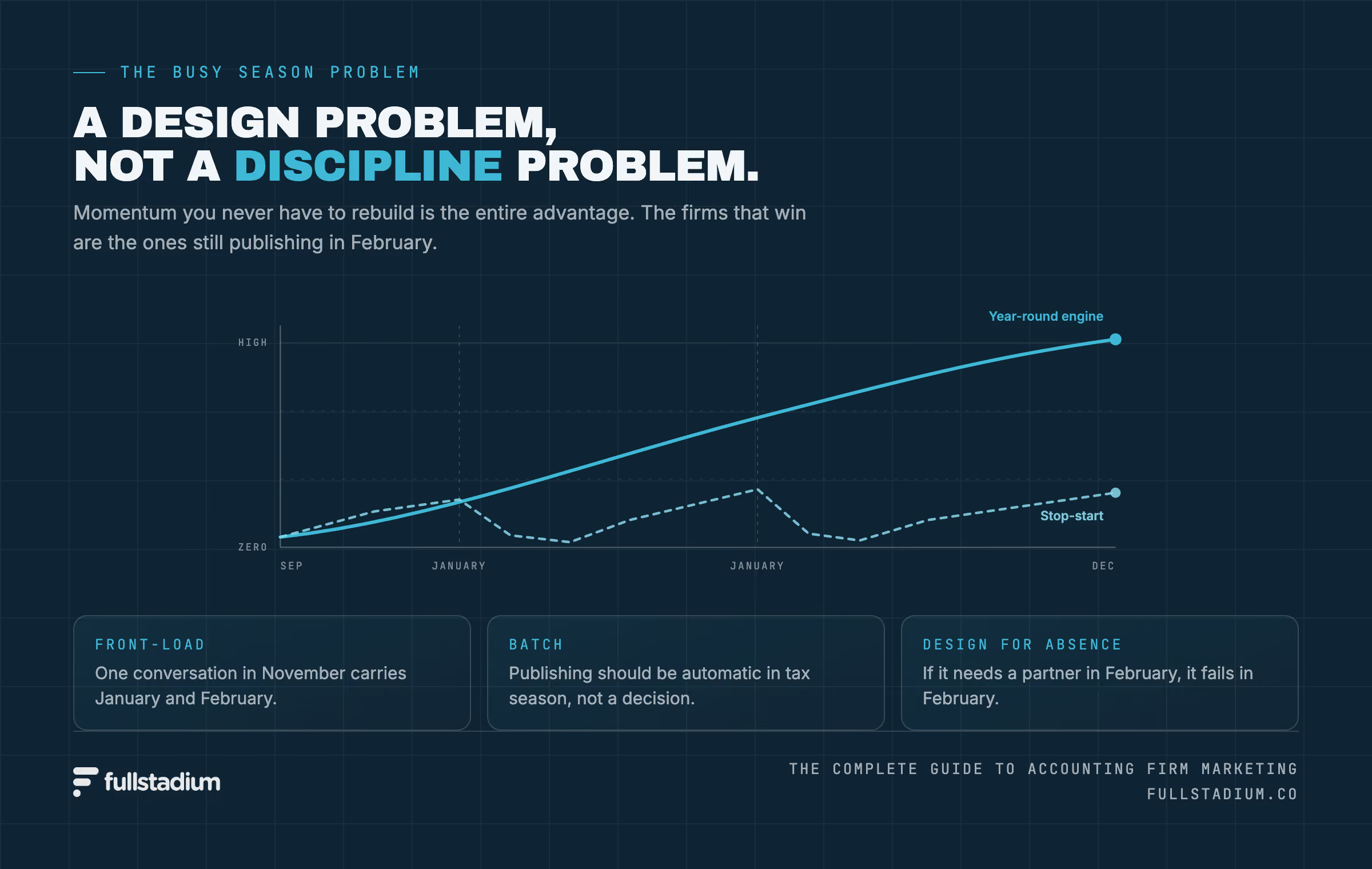
Busy season is always around the corner. You start something in September, build real momentum through the fall, and then January arrives and everything stops. By the time you surface in late April the habit is gone, the rankings have slipped, and you're starting over. Do that twice and you've concluded marketing doesn't work, when what didn't work was the stop-start.
Every firm knows this is coming. Almost nobody designs around it.
It's a design problem, not a discipline problem. The fix is to build a marketing engine that keeps rolling year round, including through the months when you have nothing to give it:
- Front-load the input. Capture material in the fall while you have capacity. One recorded conversation in November can carry January and February.
- Batch the production. Write, edit, and schedule ahead. Publishing should be automatic during tax season, not a decision someone makes.
- Design for absence. If the system requires a partner's attention in February, it will fail in February. Build the version that doesn't.
- Pick a cadence you can hold through April. If that's one post a month, publish one post a month. A rate you can sustain beats a rate you can't.
Momentum you never have to rebuild is the entire advantage. The firms that win aren't the ones with the best content. They're the ones still publishing in February.
Part 5: Being found by AI
This section didn't exist in earlier versions of this guide, and it's the one I'd pay the most attention to if you're planning the next two years.
When a business owner asks ChatGPT or Perplexity or Google's AI mode which accounting firm they should hire, they get back a short answer naming two or three firms. There's no page two. You're either in the answer or you're invisible.
Being in that answer is a different discipline from ranking. Two things are worth knowing now.
Most of the work happens off your website. For small firms, material published about you on other people's sites carries substantially more weight than anything on your own domain. One of our clients has an article about him on a third-party accounting site that outperforms his entire website in AI results. Content he didn't write and doesn't own.
Being a named individual matters. AI systems weight identifiable human experts more heavily than company pages. A partner with a consistent byline and a real presence is a clearer entity than "the marketing team."
Both should sound familiar, because they're the same three principles. Focused buys you a category thin enough to win. Human gives a model something it has to cite rather than absorb. Consistent builds the off-site corroboration that makes the citation stick.
I've written the full mechanism, including how retrieval works and why it favors small specialized firms more than most people realize, in a separate guide.
→ How AI Picks Which Accounting Firms to Cite
If you read one thing after this, make it that.
Taking action
Growing a firm isn't easy, but it isn't mysterious either. Pick a category. Say something only you could say. Build something that survives February.
If you want to talk through where your firm stands and what's reachable from here, that's what the strategy meeting is for.

Micky Deming shares insights on marketing, growth, and storytelling for accounting firms. Explore his expertise and practical strategies on the Full Stadium blog.
Frequently asked questions
It depends on client lifetime value rather than a percentage rule. If a client is worth $12,000 a year and stays four years, your affordable acquisition cost is far higher than most firm owners assume.
Most need one reliable channel outside referrals, not five. The highest-leverage options for small firms are specialized content and earned media, meaning guest articles, podcasts, and speaking in the niche you serve.
Almost always yes. Narrowing makes your message specific, your referrals clearer, and your content winnable. It also means less competition in the categories where you're trying to be found.
Six to twelve months before meaningful inbound from content, faster from paid and outbound. Firms that abandon the effort at month four account for most of the skepticism about whether it works.
By front-loading and batching. Capture and produce content in the fall, schedule it through tax season, and design a system that doesn't require partner attention in February. Stopping every January is what prevents most firm marketing from ever compounding.
Yes, but it's no longer the whole picture. A growing share of prospects get recommendations from AI assistants rather than search results, and being cited there depends heavily on what exists about you off your own site.
Trying to appeal to everyone. It produces messaging no one responds to and content no one can distinguish from anyone else's.
Related posts

How AI Picks Which Accounting Firms to Cite

Content Marketing for Accounting Firms

Lead Generation for Accounting Firms