
Lead Generation for Accounting Firms


Lead Generation for Accounting Firms: What Fills the Pipeline
Short answer: Most accounting firms don't have a lead generation problem. They have a referral concentration problem. A pipeline that works until it doesn't, with no mechanism to replace it. Fixing that means building a second channel before you need one, and accepting that the channel takes six to twelve months to produce.
Ask a firm owner where clients come from and you'll almost always hear the same answer. Referrals. Sometimes with pride, sometimes with a shrug.
Referrals are an excellent source of clients. They're also a source you don't control. You can't turn them up when you lose a large account. You can't aim them at the niche you're trying to grow. And they tend to reflect the practice you had, not the one you're building, which is why firms moving upmarket or into a specialty so often find their referral flow working against them.
The goal isn't to replace referrals. It's to stop being a single-channel business.
Word of mouth on steroids
Before the tactics, it's worth being clear about what marketing is for.
If your firm grows on word of mouth, that means someone had an experience good enough that they told another business owner about it. That's the highest compliment in professional services and you should be proud of it.
The mistake is treating it as the ceiling.
Marketing's job is to find out what those people are saying and put it in front of everyone else. What value did you bring that made them talk? What does that business have in common with the next one? Answer those two questions and you can tell the story deliberately instead of hoping it gets retold.
That's all marketing is. Word of mouth on steroids. Same message, same credibility, reaching people who don't happen to know your clients personally.
Every channel below is a way of doing that at greater volume.
Start with the math
Before choosing any channel, work out what you need. Fifteen minutes, and it eliminates most bad decisions.
Work backward:
- Revenue target. How much new revenue this year?
- Average client value. Annual revenue per client, realistically.
- Clients needed. Target divided by average value.
- Consultations needed. Most firms close between 25% and 50% of qualified consultations. Use your real number if you have it.
- Qualified inquiries needed. Not everyone who inquires is worth a consultation. Many firms find half or fewer are.
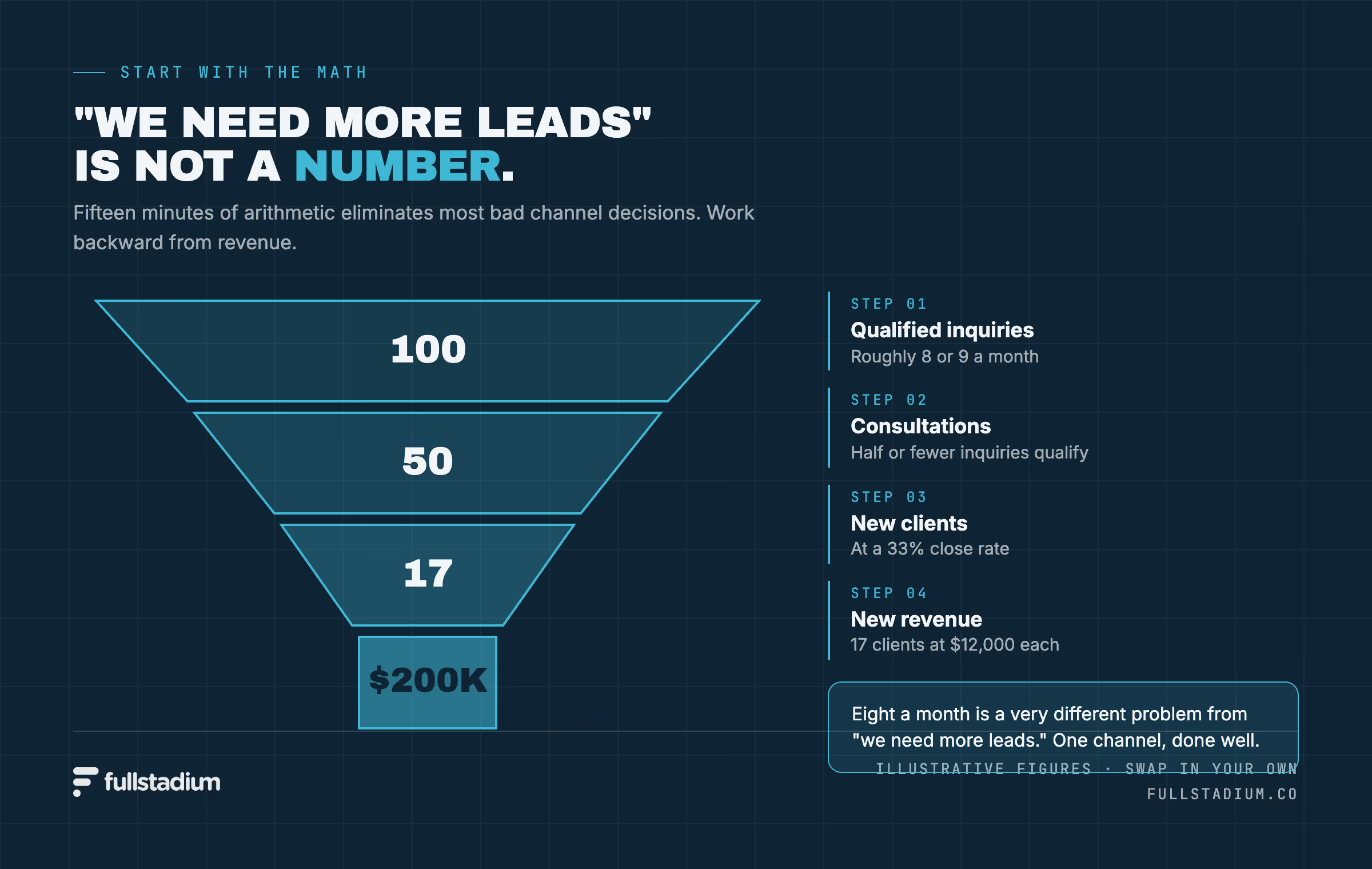
Run it and the picture clarifies fast. A firm needing $200,000 in new revenue at $12,000 per client needs about 17 clients, which at a 33% close rate is roughly 50 consultations, which might mean 100 inquiries over twelve months. That's eight or nine a month.
Eight a month is a very different problem from "we need more leads." It's achievable through one channel done well. It doesn't require a marketing department.
The other number this gives you is what you can afford to spend. If a client is worth $12,000 a year and stays four years, your acceptable acquisition cost is much higher than most firm owners assume. More on that math in the complete guide.
The channels, ranked honestly
1. Content and search
Slowest to start, and the only one that compounds. An article answering a specific question your ideal client is asking keeps working for years.
The catch is timeline. Six to twelve months before meaningful inbound, longer in competitive categories. Most firms that dismiss content marketing quit at month four, which is roughly the point where nothing has happened yet and nothing was going to.
The advantage for a specialized firm is that you're not competing with national publishers. You're competing for narrow queries in a category where very few people have published anything specific. Those are winnable.
How to produce it without a writing habit is the subject of Content Marketing for Accounting Firms.
2. Earned media and speaking
Underrated by nearly everyone, and my honest pick for the highest-leverage channel available to a small firm.
Getting published in a trade publication your prospects read, appearing on an industry podcast, or speaking at an association event does three things at once. It reaches an audience that's already assembled, it borrows the host's credibility, and it produces a durable, linkable artifact that keeps working long after the event.
That third effect is the one most firms miss. A podcast appearance isn't an hour of exposure. It's a page on someone else's respected domain, with your name on it, indefinitely.
It's also the single best thing you can do for AI visibility, which I'll come back to.
3. Referral systems
Not referrals. Referral systems. The difference is whether you have a deliberate process for staying in front of the attorneys, bankers, and consultants who serve your clients.
Most firms have five or six referral relationships that happened by accident. A quarterly touchpoint with each, plus a clear articulation of exactly what kind of client you want, converts an accident into a channel. Cheapest thing on this list.
4. Paid search
Works, and works fast, if your economics support it. Accounting keywords are expensive and the traffic is mixed. A lot of price shoppers and a lot of people who want something you don't sell.
Paid makes sense when you have a specific, high-value service with clear intent behind it and a landing page built to convert. It makes little sense as a general "we do accounting" campaign.
Test small. If it works, scale it. If it doesn't in ninety days, stop.
5. Cold outreach
Low return for most accounting firms. The exception is highly targeted outreach in a narrow niche where you can demonstrate specific relevance immediately, and even then it works better as a supplement to content than as a standalone channel.
Building something that survives busy season
Every plan above assumes you keep going, and for accounting firms that's the hard part.
Busy season is always around the corner. You start in September, build momentum through the fall, then January arrives and everything stops. By late April the habit is gone, the rankings have slipped, and you're starting over. Do that twice and you've concluded marketing doesn't work, when what didn't work was the stop-start.
This is a design problem, not a discipline problem. Front-load the input while you have capacity. Batch the production. Build something that doesn't require a partner's attention during the months when a partner has none to give. One recorded conversation in November can carry January and February.
A marketing engine that keeps rolling through tax season is worth more than a better one that dies every January. Momentum you don't have to rebuild is the whole advantage.
The part most lead gen advice is missing
Every channel above assumes a prospect finds a link and clicks it.
That assumption is eroding. A meaningful and growing share of buying research now happens inside AI assistants. Someone asks ChatGPT or Perplexity which firm they should hire for their situation and gets back a short answer naming a few options.
If you're not in that answer, you're not in the consideration set. There's no page two to be on.
What determines whether you're named turns out to be different from what determined search rankings. For small firms specifically, it's driven far more by what exists about you on other people's sites than by what's on your own. Your website matters, but it's a minority of the picture.
That's why earned media ranks as high as it does. It's not just an audience play anymore. It's the primary mechanism by which a small firm becomes citable.
Full explanation in How AI Picks Which Accounting Firms to Cite. If you're building a lead generation plan for the next two years, read that before you allocate budget.
Two things I hear constantly
"We got burned by an agency"
This comes up in most conversations I have, and it's a fair objection. There are a lot of marketing companies happy to take a retainer from an accounting firm, produce a volume of generic content, report on impressions, and never move a single client into the pipeline. Some of them are pleasant to work with. That makes it worse, not better.
If that's happened to you, the useful questions for the next vendor are specific. What exactly will exist at the end of month three that doesn't exist now? Who is writing it, and how do they know anything about my niche? What are we measuring, and when do we agree it isn't working?
A firm that can't answer those clearly is asking you to trust a process they haven't defined. You've already paid for that once.
"We tried marketing and nothing happened"
The second version of the same wound, and usually the cause is one of two things.
Either the content was indistinguishable from everyone else's, in which case it was never going to produce anything. Or it was good and it stopped at month four, which is right before the point where content starts to compound.
Both are fixable, but they're different problems with different fixes, and it's worth knowing which one you had. Look at what you published. If a competitor could have published it word for word without anyone noticing, that was the problem. If it was genuinely yours and the archive just stops in January of some year, the problem was seasonality.
Your website's job
Worth being precise, because it's where money gets misspent.
Your website is not primarily a discovery mechanism. It's the conversion event. Someone hears your name in a referral, sees you on a podcast, or gets you recommended by an AI assistant, and then goes to your site to decide whether you're real.
That means it needs to do a small number of things well:
- Say who you serve, specifically, above the fold
- Show evidence you've done this before for people like them
- Make the next step obvious and low-friction
- Load fast, especially on a phone
It doesn't need to be a comprehensive catalog of every service you offer. Most accounting firm sites fail by being a brochure when they should be an argument.
If your site is the weak link, that's something we can help with.
What to do
For a firm with limited time and no marketing staff, in order:
- Run the pipeline math. Find out how many inquiries a month you need.
- Fix the conversion path on your site. Fastest win available.
- Systematize referrals. Cheapest win available.
- Commit to one content cadence you can hold through April.
- Pitch yourself to three places your prospects already pay attention to.
Don't start five channels at once. A firm that publishes monthly and lands three podcast appearances a year will beat a firm that half-starts everything.
Where to start
If you want a clear read on where your firm stands and what's reachable from here, that's what the strategy meeting is for.

Micky Deming shares insights on marketing, growth, and storytelling for accounting firms. Explore his expertise and practical strategies on the Full Stadium blog.
Related posts
The Complete Guide to Accounting Firm Marketing

How AI Picks Which Accounting Firms to Cite

Content Marketing for Accounting Firms