
Client Stories as Proof

Client Stories as Proof: The Most Underused Asset in Accounting Marketing
Short answer: A specific client story does something no amount of claimed expertise can. It proves you've solved this exact problem before. For accounting firms the obstacle is usually confidentiality, and it's more solvable than most firms assume. The story is rarely the sensitive part.
Every accounting firm website says a version of the same thing. Trusted advisors. Personalized service. More than just tax returns.
None of it is false. All of it is unfalsifiable, which is the problem. A claim anyone could make carries no information.
A story does.
Accounting isn't boring to the people you serve
We put together a case study recently for a firm whose client was selling one business and buying another at the same time. The due diligence was enormous. So was the reliability required, and the trust. That transition determined the financial future of a family, and the accountant was a partner through every step of it.
When we interviewed the client, the gratitude was immediate and it had nothing to do with the accuracy of any return. It was about having someone in their corner during the biggest decision they'd ever made.
That's the story. It was sitting there the whole time, and without a deliberate effort to capture it, it would have stayed a nice memory in one person's head.
Firm owners consistently underestimate this. Accounting has a reputation for being dull, and a lot of accountants have absorbed that reputation about their own work. But business owners care deeply about what they've built. They take pride in it. They're hungry for someone they can trust to help them get where they're going, and when they find that person it matters enormously to them.
Don't sell yourself short. Show some personality. Tell the stories. Share the insights that give your clients an edge. The work you do is worth talking about.
Word of mouth on steroids
Most accounting firms grow on word of mouth, and rightly proud of it. Someone had an experience good enough that they told another business owner about it. That's the highest compliment in professional services.
The mistake is treating that as the ceiling.
Marketing's job is to find out what those people are saying and put it in front of everyone else. What value did you bring that made them talk? What does that business have in common with the next one? When you can answer those two questions, you can tell the story deliberately instead of hoping it gets retold.
That's what good marketing is. Word of mouth on steroids. Same message, same credibility, reaching people who don't happen to know your clients personally.
Which means your existing referrals are free research. The next time one comes in, ask what they heard. The phrasing they give you is usually better marketing copy than anything you'd write, and it tells you which of your capabilities people find worth mentioning.
Why firms don't do this
Three reasons, all worth taking seriously.
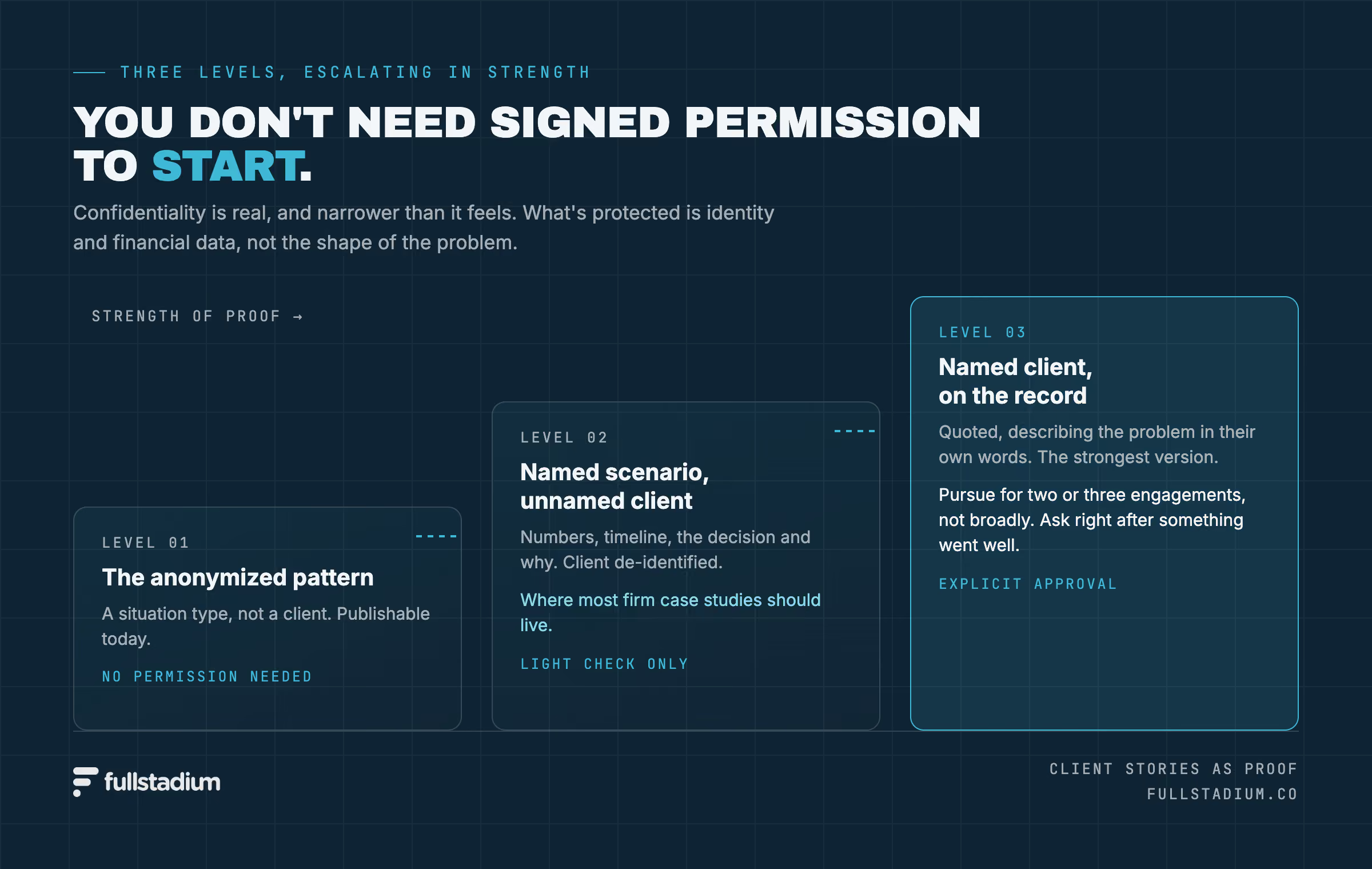
Confidentiality. Real and non-negotiable. But narrower than it feels. What's protected is the client's identity and their financial data. The shape of the problem, the reasoning you applied, and the category of outcome usually aren't.
Modesty. A lot of accountants find self-promotion distasteful. Reporting what happened isn't bragging, though. If you fixed something, describing the fix is information the next person needs.
Effort. Case studies feel like a project. Someone has to interview the client, get approval, write it up, design it. It never rises above other priorities.
That last one is the real killer, and it's solvable by changing when the story gets captured.
Three levels, escalating in strength
You don't need signed permission to start. There's a ladder.
Level 1: The anonymized pattern
No permission needed. You're describing a situation type, not a client.
"We see this constantly with nonprofits that grew past $2 million without changing how they book restricted funds. It usually surfaces during an audit, and by then it's three years of reclassification."
Publishable today. Specific enough to signal real expertise, and it names no one. Most firms could produce fifty of these from memory and publish exactly none of them.
Level 2: The named scenario, unnamed client
More detail. Numbers, timeline, the decision you made and why, with the client de-identified. Worth a quick check if the situation is distinctive enough to be recognizable in a small market.
This is where most accounting firm case studies should live. Substantially stronger than Level 1 and requires far less than a full approval cycle.
Level 3: The named client, on the record
The strongest version and the hardest to get. A named client, ideally quoted, describing the problem in their own words.
Worth pursuing for two or three engagements rather than broadly. The right candidates are clients who genuinely like you, whose outcome was clear, and who have some marketing instinct of their own. They often see the mutual benefit immediately.
Ask at the right moment. Not during busy season. Not in a cold email. Ask right after something went well, when the client is expressing gratitude anyway. That's when the answer is yes.
The capture problem
Here's why case studies never get written. They're treated as a separate project requiring a separate effort.
The fix is to stop treating them as a deliverable and start treating them as a byproduct.
We run monthly recorded interviews with the firm owners we work with. Thirty minutes. I ask questions, they answer, and it becomes the month's content. Client stories emerge constantly, because when you ask an accountant "what's a situation that surprised you recently," you get a case study whether you asked for one or not.
The story gets captured while it's fresh. Six months later the details have blurred into "we helped a client save on taxes." At the time, the owner remembers the exact number and the exact reason.
You can do this yourself. Once a month, open a recorder and answer three questions out loud:
- What's a client situation that surprised me this month?
- What did I fix that the previous firm missed?
- What did a client believe that turned out to be wrong?
Ten minutes of talking produces material you'd never have sat down to type. Then decide which level each story can be published at.
The broader method is in Content Marketing for Accounting Firms.
What makes a story land
Structure matters less than people think. Four things matter a lot.
A specific starting condition. Not "a client was struggling." What were they doing, and what was it costing them?
The reasoning, not just the result. The valuable part isn't that you saved them money. It's why the previous approach was wrong. That's what demonstrates judgment, and it's what a prospect uses to evaluate whether you'd catch their problem.
A real number wherever possible. Even a rounded, anonymized one. Numbers make a story feel like an event rather than a genre.
The client's language. How they described the problem before you fixed it is almost always better phrasing than how you'd describe it professionally. It's also how the next prospect will search for it.
That last point is worth sitting with. The gap between how buyers phrase problems and how practitioners name services is where a lot of marketing goes wrong. Your clients' own words are free research.
The second reason to do this now
Client stories have always been good sales material. They've recently become something else too.
When someone asks an AI assistant which firm to hire for a specific situation, the model assembles an answer from what exists about firms on the web. Undifferentiated content gives it nothing to attach to your name. It summarizes the consensus and cites whoever has the most authority.
A specific, detailed account of solving a specific problem is different. It's original material. It's attributable. It's the kind of thing a model has to cite rather than absorb, because it can't be generated from general knowledge.
And it's most powerful when it lives somewhere other than your own website. A story about your work published in a trade outlet, or told on an industry podcast, carries considerably more weight than the same story on your services page. For small firms that off-site layer is the majority of the picture, and I've laid out the full mechanism in How AI Picks Which Accounting Firms to Cite.
So the client story does double duty. It converts the prospect already looking at you, and it makes you findable to the ones who haven't heard of you.
Where to put them
- A dedicated page, once you have three or more at Level 2 or above
- Inside relevant service pages, where the story does more work next to the offer than in a separate archive
- In your monthly content, one at a time
- In pitches and proposals, where they convert hardest
- In guest articles and podcast appearances, where they compound
Don't build a case study library before you have stories. Build the capture habit first.
The short version
You almost certainly have twenty publishable stories right now. The obstacle isn't confidentiality and it isn't modesty. It's that nobody wrote them down while they were still specific.
Start recording. Sort out permissions later.
If you want help turning what you know into stories worth telling, that's what the strategy meeting is for.

Micky Deming shares insights on marketing, growth, and storytelling for accounting firms. Explore his expertise and practical strategies on the Full Stadium blog.
Frequently asked questions
Yes, at several levels. Anonymized situation patterns need no permission. De-identified scenarios with real details usually need only a light check. Named client stories require explicit approval, which is easier to get than most firms expect if you ask at the right moment.
Describe the shape of the problem and your reasoning rather than the client's identity or financial data. "A nonprofit that outgrew its fund accounting setup" communicates expertise without disclosing anything protected.
Immediately after a good outcome, while they're already expressing appreciation. Not during busy season, and not by cold email months later.
A specific starting condition, the reasoning behind the fix, a real number, and the client's own language describing the problem. The reasoning is the part that demonstrates judgment.
Yes. Specific, original accounts are material an AI tool must attribute rather than summarize, particularly when published off your own domain on sites your industry already trusts.
Related posts
Content Marketing for Accounting Firms

How AI Picks Which Accounting Firms to Cite
The Complete Guide to Accounting Firm Marketing