
Social Media Marketing for Accounting Firms


Social Media Marketing for Accounting Firms: One Input, Many Outputs
Short answer: Accounting firms shouldn't build a social media strategy. They should build a content strategy and let social media distribute it. The firms burning out on social are the ones treating each platform as a separate content problem, and for a firm with no marketing staff that's unsustainable by month three.
Every accounting firm I talk to has the same social media history. Someone set up the profiles. There was a burst of posting. Then busy season hit, and the last update is from fourteen months ago.
That isn't a discipline failure. It's a design failure. The model was wrong from the start.
The mistake: treating social as a content source
Most advice tells you to post consistently, engage with your audience, and provide value. All true, all useless, because it never addresses where the material comes from.
If every post requires someone to think of something to say, you have invented a daily creative obligation for a firm whose billable people cannot absorb one. It will fail. It always fails.
The fix is structural. Social media isn't where content gets created. It's where content gets distributed.
One conversation, a month of posts
Here's the model we run, and it's the reason our clients don't burn out.
One recorded interview per month with the firm owner. Thirty minutes. From that single conversation:
- A long-form article
- A video, and short clips cut from it
- An email
- And roughly a dozen social posts, each one a distinct idea the owner said out loud
The firm owner's total social media workload is zero. They already did the work when they answered the questions.
That's the whole trick. You aren't generating twelve ideas a month. You're finding twelve ideas inside something that already exists. Much easier job, and it produces better posts, because they're excerpts from real thinking rather than manufactured content.
If you want the mechanics of the interview method itself, that's in Content Marketing for Accounting Firms.
Where accounting firms should be
Not everywhere. Two platforms, done properly, beat five done badly.
LinkedIn is the one that matters
For nearly every accounting firm, LinkedIn is the platform. Your buyers are there in a professional context, organic reach for text posts is still meaningfully better than most networks, and the content type that performs there, specific professional insight, is exactly what you have.
What works on LinkedIn for accountants:
- A specific mistake you keep seeing, and what it costs
- A short story from an engagement, anonymized
- A contrarian take on conventional advice in your niche
- A plain-language explanation of something clients get wrong
- Commentary on a change in your industry and what it means practically
What doesn't work: tax deadline reminders, holiday graphics, "we're hiring" as your only posting pattern, and anything that reads like it was written by a committee.
Notice what's on the first list and not the second. Every item that works has a person behind it. Accounting has a reputation for being dull, and a lot of firms post like they've accepted that. Your clients haven't. Business owners care enormously about what they've built, and when an accountant helps them through something that matters, it matters to them for years. Show some personality. Tell the stories. Share the insight that gives someone an edge.
Post as a person, not as the firm. Individual profiles outperform company pages by a wide margin, and there's a second reason to care about that now which I'll get to below.
YouTube if you'll commit to it
Video is a heavier lift, but the compounding is real. A firm owner explaining a niche financial problem clearly, on video, is genuinely rare and highly credible.
The version that works without a production budget: record the monthly interview on video and edit out the interviewer. What's left is the firm owner talking directly about their expertise, which is what you'd have tried to script anyway, except better, because it's unscripted.
That footage yields a long-form video plus a set of short clips. Same input, more outputs.
The ones to skip
Facebook, if your clients are consumers and you already have a following there. Otherwise it's maintenance work with little return. Instagram and TikTok can work for firms serving specific consumer-facing niches, but for most B2B accounting practices they're a distraction from the two platforms that matter.
X is largely a waste of time for accounting firms at this point unless you're already active and enjoying it.
The thing that changed
There's a reason to care about social media now that has nothing to do with followers.
AI assistants pull from social platforms when they assemble answers. LinkedIn in particular shows up regularly as a cited source when someone asks an AI tool about a professional topic or a specific expert. Your posts aren't just reaching your connections. They're part of the corpus that gets consulted when someone asks who they should hire.
Which reframes what a "good" post is. Vanity-metric posts are still vanity. But a post where you explain something specific about your niche, under your real name, on a platform that gets crawled and cited, is doing durable work regardless of how many likes it gets.
Same principle that drives the rest of our approach: most of what makes a firm citable happens off your own website. Social is one channel of that. Full mechanism in How AI Picks Which Accounting Firms to Cite.
It also means the "post as a person" advice above has a second justification. A named individual with a consistent professional presence is a much clearer entity for a model to recognize than a company page.
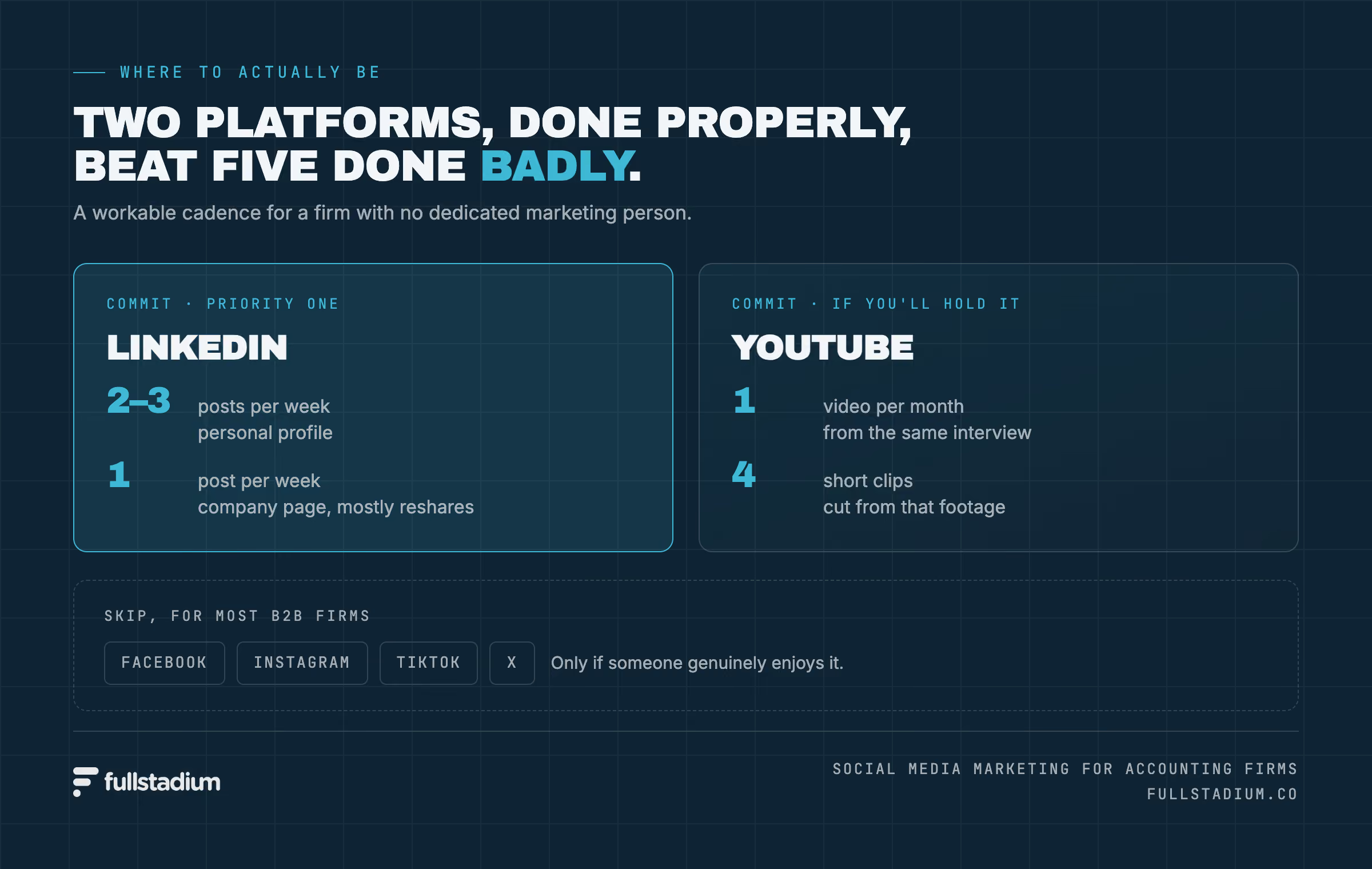
A workable cadence
For a firm with no dedicated marketing person:
- LinkedIn, personal profile: 2–3 posts per week
- LinkedIn, company page: 1 post per week, mostly reshares
- YouTube: 1 video per month, plus clips
- Everything else: only if someone genuinely enjoys it
Batch it. Pull the month's posts out of the interview transcript in one sitting, schedule them, and move on. The failure mode is deciding what to post each morning.
Batching is also what gets you through busy season. Social is usually the first thing to die in January and the hardest to restart, because the algorithm forgets you faster than search does. If you record and schedule in November, February takes care of itself.
Engagement matters more than posting volume. Commenting substantively on other people's posts in your niche builds more than another broadcast does. But it has to be real commentary, not "Great post!"
The point
If social media feels like a burden, the problem is almost certainly that you're generating content instead of distributing it.
Fix the input and the output takes care of itself.
If you want to talk through what that looks like for your firm, that's what the strategy meeting is for.

Micky Deming shares insights on marketing, growth, and storytelling for accounting firms. Explore his expertise and practical strategies on the Full Stadium blog.
Frequently asked questions
LinkedIn, for nearly every firm. Your buyers are there in a professional context and the content that performs there is the content you're naturally able to produce.
Personal, primarily. It gets substantially more reach, it reads as more credible, and a named individual is a clearer signal of expertise, both to prospects and to AI tools that cite sources.
Two to three times a week on a personal LinkedIn profile is a realistic target that most firms can sustain. Sustainability matters more than frequency.
Stop trying to think of posts. Extract them from something longer: a recorded conversation, a client question, an article you wrote. Creating twelve posts is hard. Finding twelve ideas inside an existing thirty-minute conversation is easy.
Rarely directly. It works as a credibility layer. Prospects who found you elsewhere check your presence before reaching out, and referrals get validated there. Treat it as trust infrastructure, not a lead source.
Related posts

Content Marketing for Accounting Firms

How AI Picks Which Accounting Firms to Cite
The Complete Guide to Accounting Firm Marketing