
Why Your Accounting Firm Needs a Case Study

Why Accounting Firms All Sound the Same
Pull up five accounting firm websites in your city. I'd bet at least four of them promise peace of mind. Personalized service. A trusted partner.
None of that is wrong. The problem is that every firm says it, so none of it sets you apart.
A prospect reading those pages can't tell you from the firm down the street. An AI engine answering "who's the best CPA for restaurants near me" can't either.
Case studies fix that. Here's why I'm pushing every firm we work with to publish at least one.
How a Case Study Shows Your Value
I started in journalism before I got into accounting firm marketing. The first rule they drill into you is show, don't tell.
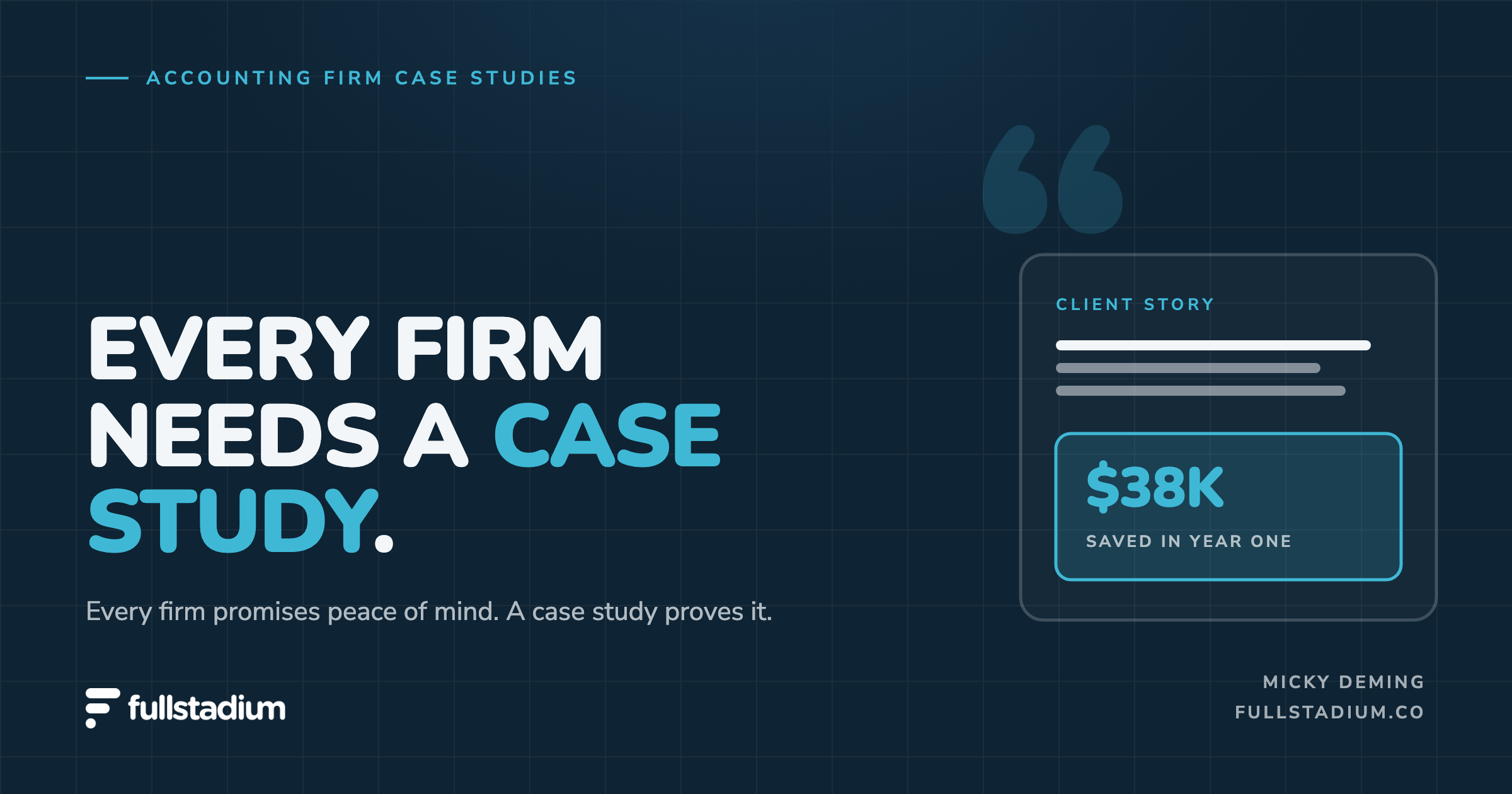
"We help business owners keep more of what they earn" is telling. A line like "We restructured a dental practice's entity setup and cut their tax bill by $38,000 in year one" is showing.
The prospect can picture it. They start doing the math on their own business. You gain credibility because they realize you understand their exact situation.
Your work is hard to see. Clean books and a well-timed tax strategy don't photograph well. A case study gives your work a before and after: the client was stuck here, you did this, and now they're here.
Case Studies Work Like Referrals
Choosing an accountant is a trust decision. A prospect is handing you their numbers, their payroll, and sometimes their family's finances.
Before they trust you, they want to see that someone like them already did. That's why referrals work so well for accounting firms.
A case study is a referral that's available around the clock to everyone who lands on your site. Your client tells the story in their own words, with their name attached. That carries more weight than anything you could say about yourself.
Do Case Studies Help With AI Search?
More of your prospects are asking ChatGPT, Perplexity, or Google's AI Overviews to recommend an accountant. Those tools pull from live sources and decide who gets cited. We have good research on what they favor.
The foundational study is GEO: Generative Engine Optimization, from researchers at Princeton and IIT Delhi, presented at KDD 2024. They tested nine content changes across a benchmark of 10,000 queries. Adding statistics, quotations, and cited sources boosted a page's visibility in AI answers by up to 40%. Keyword stuffing did little to nothing.
They also found these gains helped lower-ranked sites the most. That's good news for a small firm going up against national brands.
Now look at what a good case study contains. Specific numbers. A client quote. A named business in a named industry. It's made of the exact ingredients the research says AI engines reward.
Google points the same direction. In December 2022 it added "Experience" to its quality rater guidelines, turning E-A-T into E-E-A-T. First-hand proof that you've done the work matters.
Structure helps, too. Problem, solution, result is an easy shape for a language model to summarize and cite.
And case studies travel. For small firms, most AI visibility comes from what other sites say about you. A good story gives your client something to share, gives your software partners a success story to feature, and gives you a ready-made pitch for industry publications.
Case Studies Prove You Know Their Industry
A restaurant owner wants to know you understand food costs and tip reporting. A med spa owner wants to know you get how their revenue and provider payroll work.
A page that says "we serve small businesses" can't show that. A case study about a med spa can. It proves you speak the language, know the problems, and understand the numbers of their industry.
It helps AI engines make the same connection. When someone asks for an accountant who works with med spas, a published med spa story is the kind of evidence that ties your firm's name to that answer.
If you're building toward a niche, case studies are where you plant the flag. Three stories in one industry say more than any "industries we serve" list.
How to Repurpose One Case Study
A good case study doesn't stop at your results page. It becomes a LinkedIn post, a newsletter feature, a short video with your client, and a slide in your next presentation.
It also changes your sales conversations. When a prospect asks, "Have you worked with someone like me?" you send a link instead of a promise.
How to Write Your First Case Study
You don't need a library of them. Start with one.
Pick a client you love working with, where the before and after is clear. Ask for 30 minutes of their time. Get permission to use their name and their numbers.
Then tell the story the way a reporter would: where they were, what you did, and what changed.
Your work already creates results. A case study makes them visible to prospects and to the AI tools they're asking.
Want help telling your first client story? Get started here.

Micky Deming shares insights on marketing, growth, and storytelling for accounting firms. Explore his expertise and practical strategies on the Full Stadium blog.