
The 1-Page Growth Plan for Accounting Firms

Short answer: An accounting firm growth plan needs two things, a goal and channels. Write down who you serve, turn your revenue goal into a monthly number of qualified leads, pick three or four channels that can produce them, and give each channel an owner. Then compare plan to actual every month, the same way you'd review a client's budget. All of it fits on one page.
We're heading into a new year, and for a lot of accounting firms this is when the planning starts. What will revenue look like next year? Will we grow? Do we have a plan to grow? Even if the goal is to hold steady, you still need a plan.
Over the last few months I've had a lot of conversations with accounting firm owners about marketing plans, and I keep hearing the same questions. How much should we be doing? Which channels work for a firm like ours? Why did the plan we made in January stop getting used by March?
There's usually some frustration behind those questions, too. Most of the owners I talk to know what they should be doing for marketing. It just doesn't happen consistently, and they're tired of feeling like growth is something that happens to them instead of something they can plan.
So I wanted to write down the process we use at Full Stadium to build a growth plan with the firms we work with. It's simple on purpose, and it fits on one page. I hope it's helpful whether you ever work with us or not.
First, it's worth being honest about how most firms "plan" growth today. Usually it looks like this: take what happened last year and project some level of growth on top of it. If most of your new clients come from word of mouth, that plan is essentially hoping for the right number of referrals.
Referrals are great. I want you to keep getting them. But I'd rather take an intentional route, with a plan that hits the goal on its own and referrals as the bonus on top.
Why your firm needs goals, even if you're not trying to grow
Some owners tell me they aren't trying to grow. They like the size of their firm and don't want to add staff. That's completely fair. I'd still encourage you to set goals, for three reasons.

Goals filter your decisions and cut waste. Every month something new shows up: a sponsorship pitch, a new marketing tool, an idea for a podcast. Without a goal, every option looks reasonable, and you end up spending time and money on a little bit of everything. With a goal, you can ask one question: does this help us get the leads we need from the channels we chose? Most things fall away pretty quickly.
Goals give you accountability, so you can learn and improve. If you never set a number, you can never miss it, and you can never learn from it either. A goal turns marketing from a vague activity into something you can measure, review and get better at.
Goals improve the quality of your clients. This is the one firms that aren't chasing growth tend to overlook. More leads means you can be more selective. You can say no to poor fits, take on clients who match the work you do best, and charge prices that reflect your value. When you only get a handful of leads a year, you tend to take almost everyone who calls, at whatever price they'll accept. Even if your revenue and headcount stay flat, replacing weaker clients with better ones is real progress.
Why accounting firm marketing plans fail
Here's what we hear on almost every call from owners whose marketing isn't getting traction:
- "We know what to do, it just doesn't happen." A newsletter that goes out whenever someone has time. A YouTube channel that's been quiet for a year. One firm had paid for an email tool for years without ever sending a newsletter.
- "We never know if the next client is coming." Growth is stuck on word of mouth and referrals, so it comes in waves. Or it's stuck on a single channel that has a ceiling, like ranking #1 in search for terms almost nobody searches.
- "Nobody here can run it." There's no one in-house to own marketing, and the owner wants out of sales and marketing. One owner put it perfectly: "I'm not really looking for a strategy person, I just need someone to get it done."
- "We have stuff we never use." Client lists, past-prospect lists, recorded calls, old videos, referral partners who'd happily send more work if anyone stayed in touch.
Every one of those firms knows what to do. What breaks down is the planning and the follow-through, and it usually comes down to three things.
The focus isn't narrow enough. A lot of plans try to reach everyone, everywhere. The target is "small businesses," and the channel list includes every platform anyone has mentioned. When the focus is that wide, nothing gets done well enough to work. A narrow focus on who you serve and a few channels you can sustain will beat a broad plan almost every time.
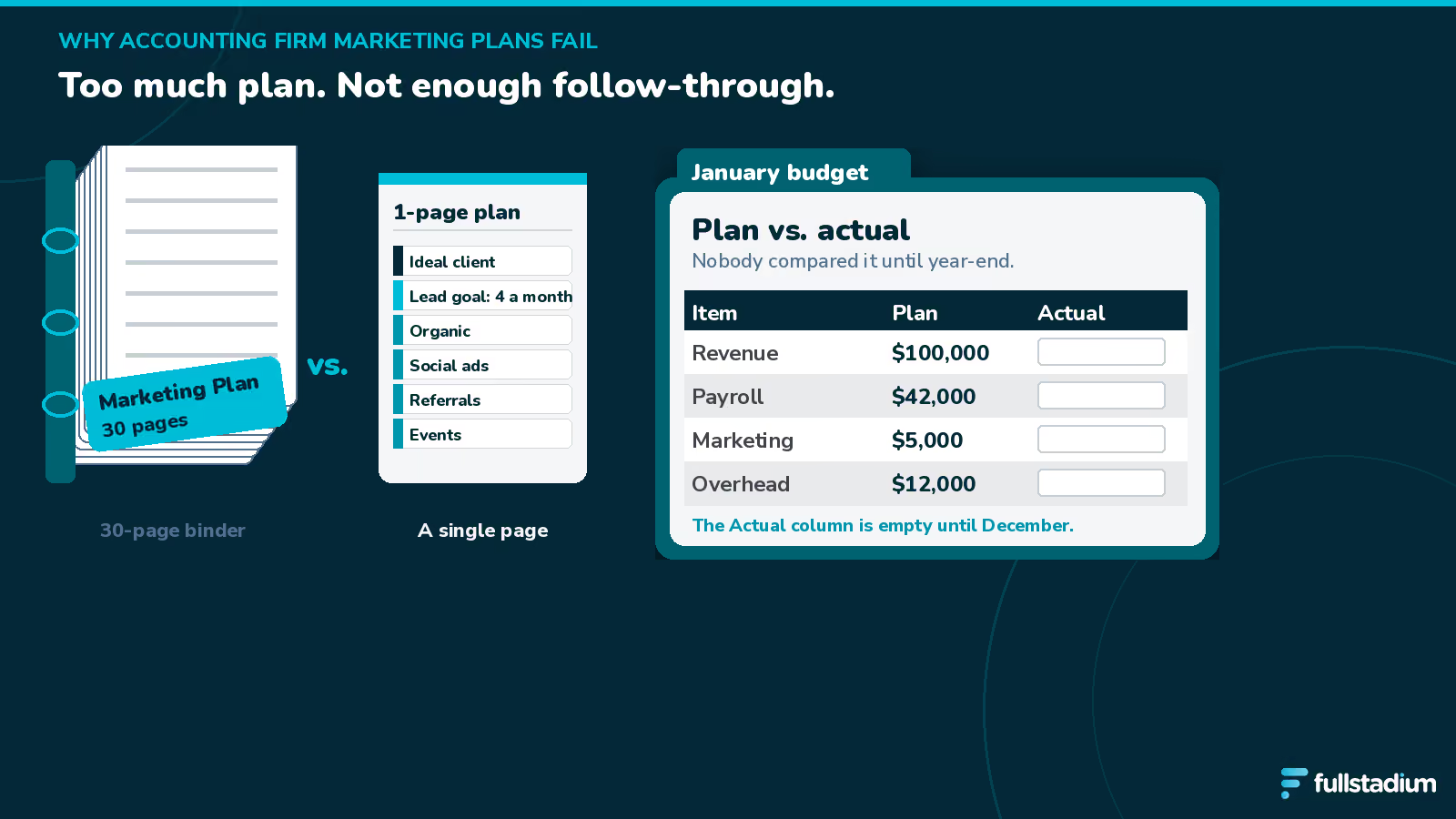
There's too much in the plan and no ability to execute. I've seen marketing plans that run 30 pages, with personas, competitive analysis and a dozen tactics. There's a lot of information and no real, sustainable plan for who does what each month. If the plan depends on a busy owner finding extra hours during tax season, it's not going to survive tax season.
There's a newer version of this, too. A lot of owners now ask ChatGPT or Claude to build their marketing plan, and they get back pages of ideas. They're good ideas, and many of them would work. But there's so much on the list that nothing gets done.
There's no follow-through. You've seen this with your own clients' budgets. A client builds a careful budget in January, it goes into a folder, and nobody compares it to actuals until year-end, when it's too late to change anything. The budget was fine. Nobody looked at it again. Marketing plans fail the same way.
How to build a 1-page growth plan
At Full Stadium we capture the whole plan on one page, so it's easy to follow and easy to stay accountable to all year. All you need is a goal and channels, and both start with one line at the top of the page.
Step 1: Write down who you serve
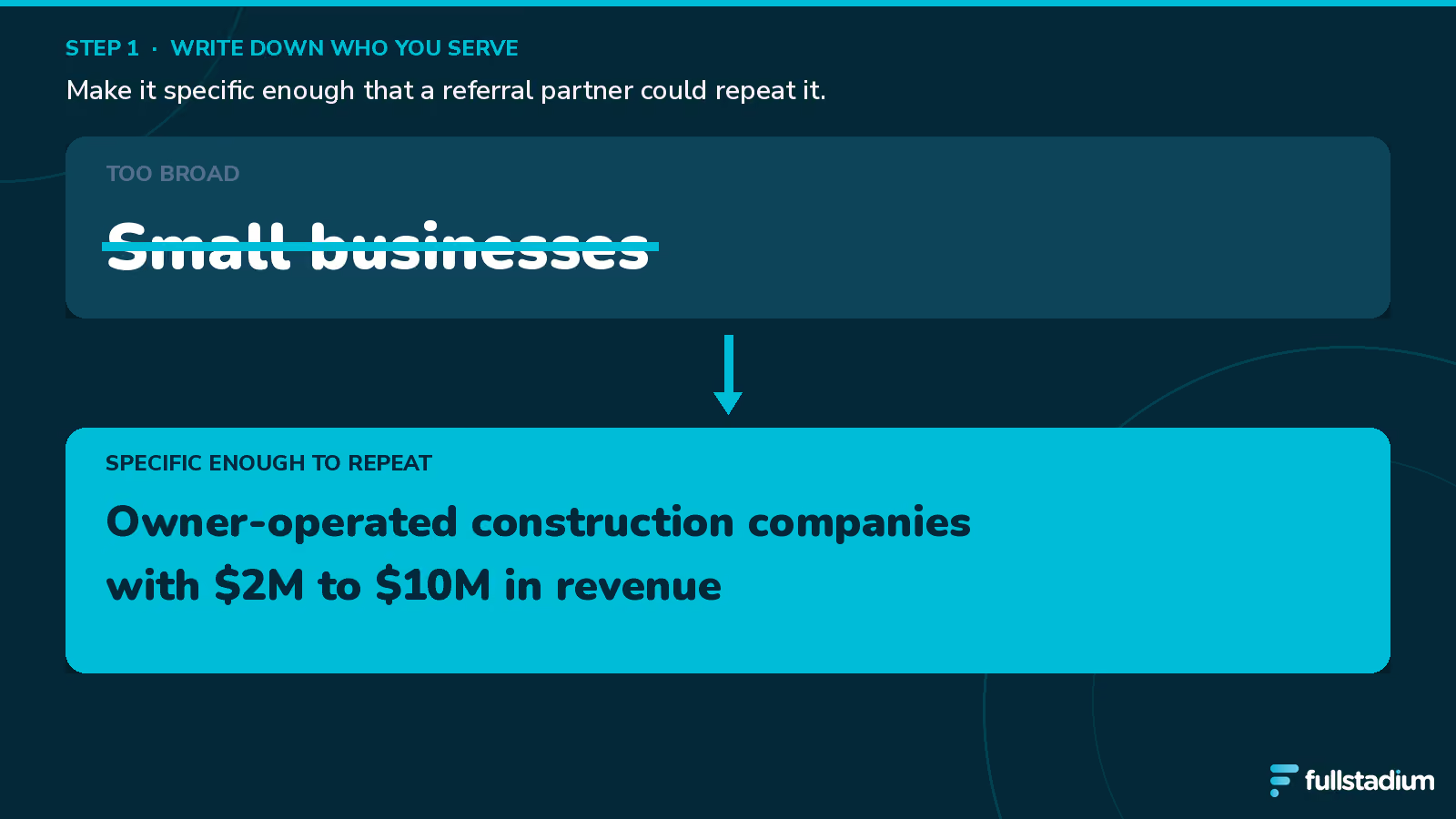
Before any numbers, write down your ideal client in one sentence. Make it specific enough that a referral partner could repeat it. "Personal injury law firms with 5 to 20 attorneys that run on Clio" gives a partner something to say. "Small businesses" gives them nothing.
This line does a lot of work. It tells you who each channel is supposed to reach, what your content should be about, and who your referral partners should send. When a new idea shows up, it's the first filter.
Step 2: Turn your revenue goal into a lead target
You have a revenue goal. You also have a sales process, and if you know how often new leads become clients, you have a close rate. Let's say yours is 33%, or one in three.
If everything you get is word of mouth, your close rate may be closer to 50%, because referred leads already trust you. As you drive more leads from other channels, that rate will come down, so plan for it.
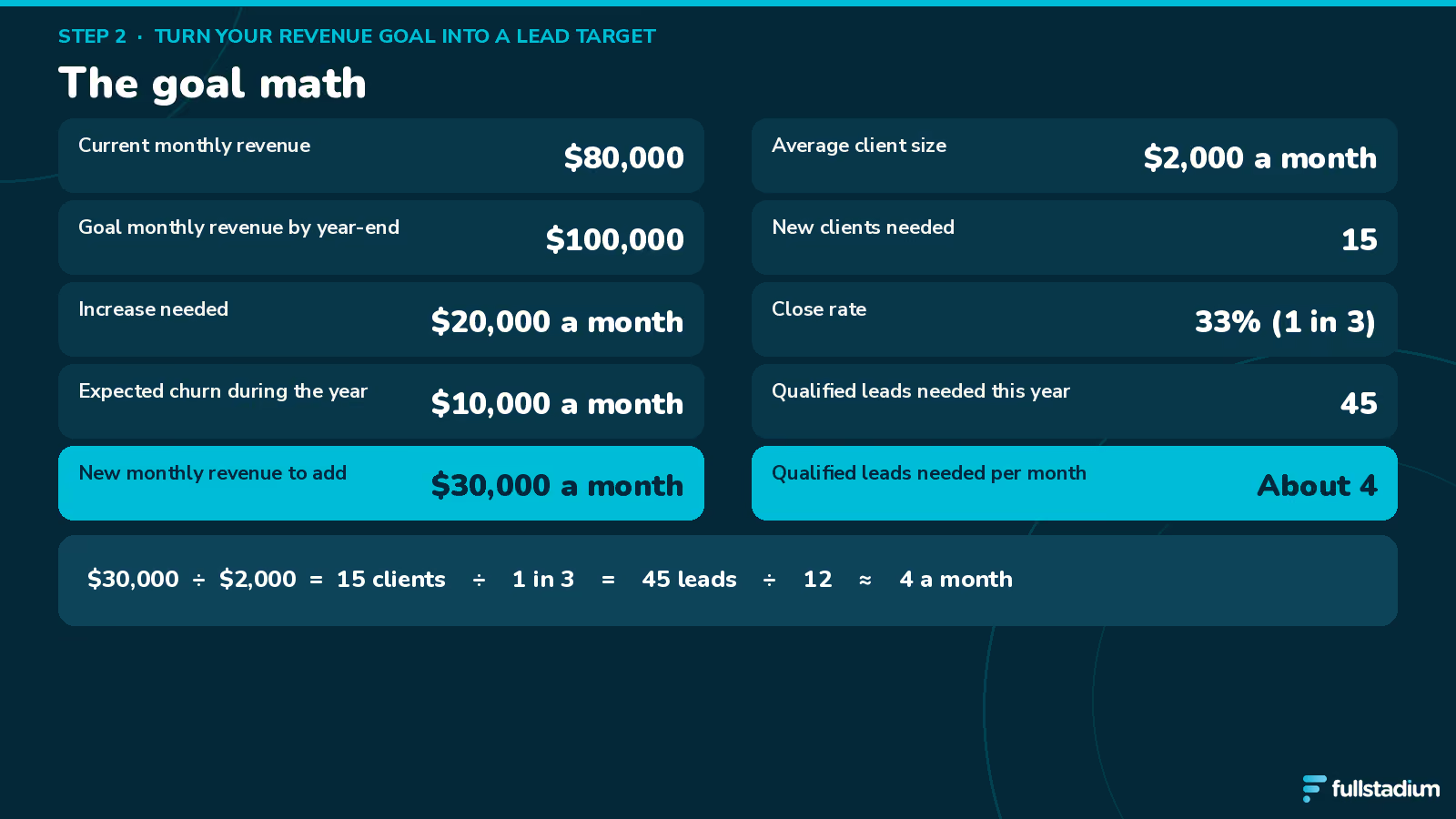
Here's an example. Say you're at $80,000 in monthly revenue right now, and your goal is to reach $100,000 a month by the end of the year. That means you need to increase by $20,000 a month.
But you'll also lose some clients during the year. Some retire, some sell their business, some outgrow you. Let's say you expect about $10,000 in monthly revenue to churn. So the real goal for new monthly revenue added is $30,000.
If your average client is $2,000 a month, you need to add 15 new clients. With a one-third close rate, you need 45 qualified leads. Spread over twelve months, that's about 4 qualified leads a month.
That's the whole goal. Four leads a month is a lot less overwhelming than "we need to do more marketing." Now the entire job of your marketing is to drive about 45 qualified leads this year.
Step 3: Choose your channels
Here are the channels we see work most often for accounting firms:
- Referral partners. Yes, referrals are a channel you can work intentionally. Make a short list of your top referral partners and put a lead goal next to it, even if it's just one a month. Give them regular touch points, and tell them exactly who your ideal client is, so they know who to send and who not to send. One owner I spoke with had a great insight here: partners deserve their own communication, like a quarterly partner newsletter and in-person meetings, because you talk to a partner differently than you talk to a client. If three months go by with no referrals, you can check whether you did anything to earn them.
- Client referrals. Do great work, and then it's OK to ask. Something as simple as "I really like working with clients like you. Do you know anyone else in a similar spot?" works, because it tells them exactly who you help. Between partners and clients, some firms hit their whole lead goal.
- Organic content. When you do great work for a specific niche, talk about it. Explain the problems you solve and the value you bring, on your website and on social media. That tells search engines and AI tools you're the authority in that space. Commit to an amount of video and written content, keep it up for a year, and track whether leads come from it.
- LinkedIn. Post from your own personal profile. Talk about what you're seeing in your niche and let your personality show. People are getting tired of content that sounds like AI, so anything human has a better chance of standing out. If you need a starting point, here's more on posting regularly on a set cadence.
- Newsletter. When we help firms restart a newsletter, they almost always find revenue. Some clients upgrade to more services, and some leads from years ago come back and sign. It's also the easiest way to stay in front of referral partners.
- Paid ads. Ads are fuel on the fire. If you haven't found a message that works yet, ads burn money while you figure it out. Once referrals and organic content show you what resonates, ads put that proven message in front of more of the right people.
- Sponsorships and events. Podcasts (sponsoring or appearing as a guest), co-marketing with partners, industry associations and local events where your ideal clients already gather. Even if it's one event a quarter, put it on the list and track what it produces.
You don't need all seven. Pick the three or four that fit your firm and that you can keep up all year.
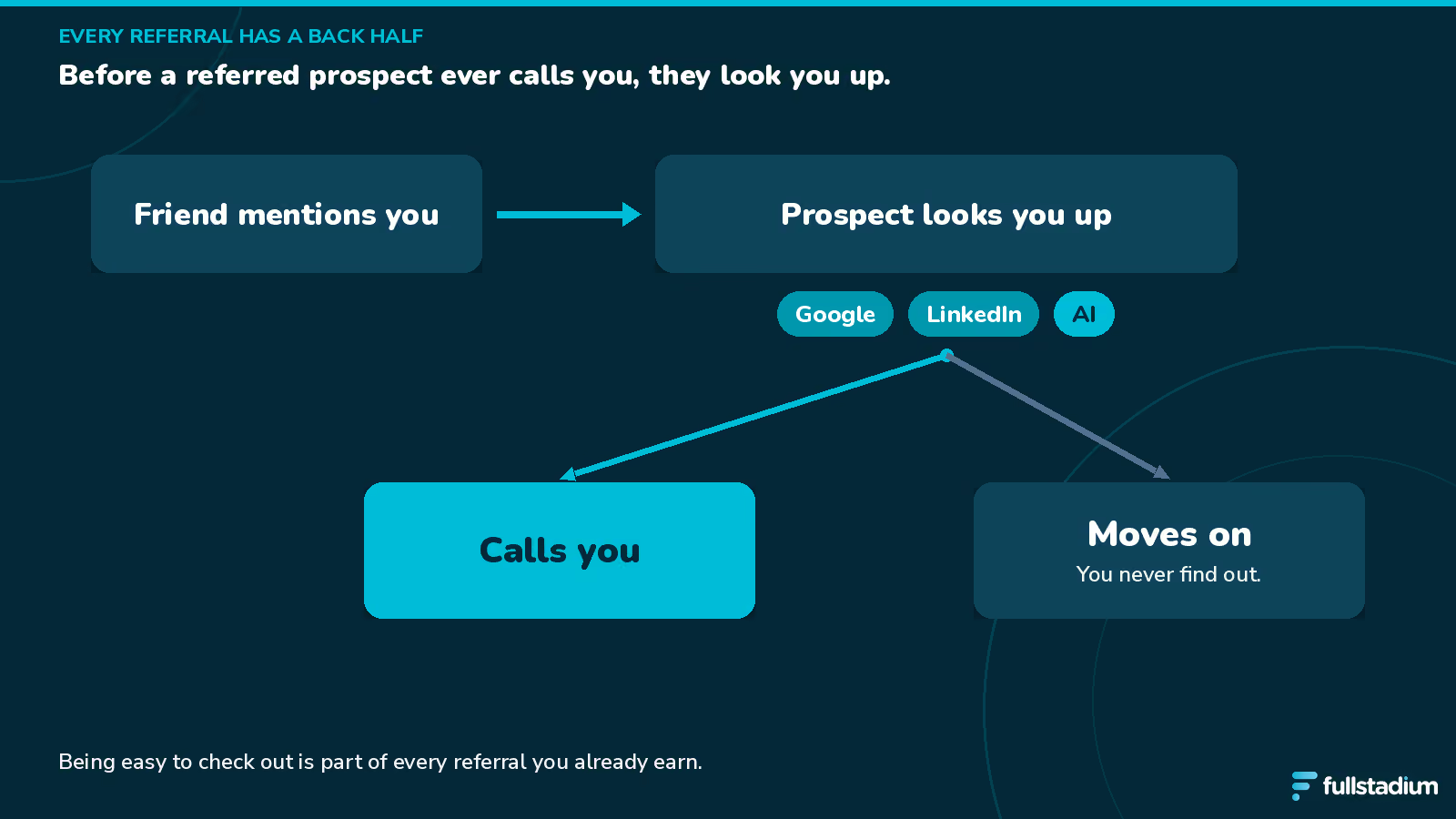
And remember that every referral has a back half. Before a referred prospect ever calls you, they look you up. They Google you, check LinkedIn, and more and more of them ask an AI tool, "Is this firm any good? What do they specialize in?" If they can't find a clear picture of who you serve, they move on, and you'll never know it happened. That's why the organic channel supports the referral channel. Being easy to check out is part of every referral you already earn.
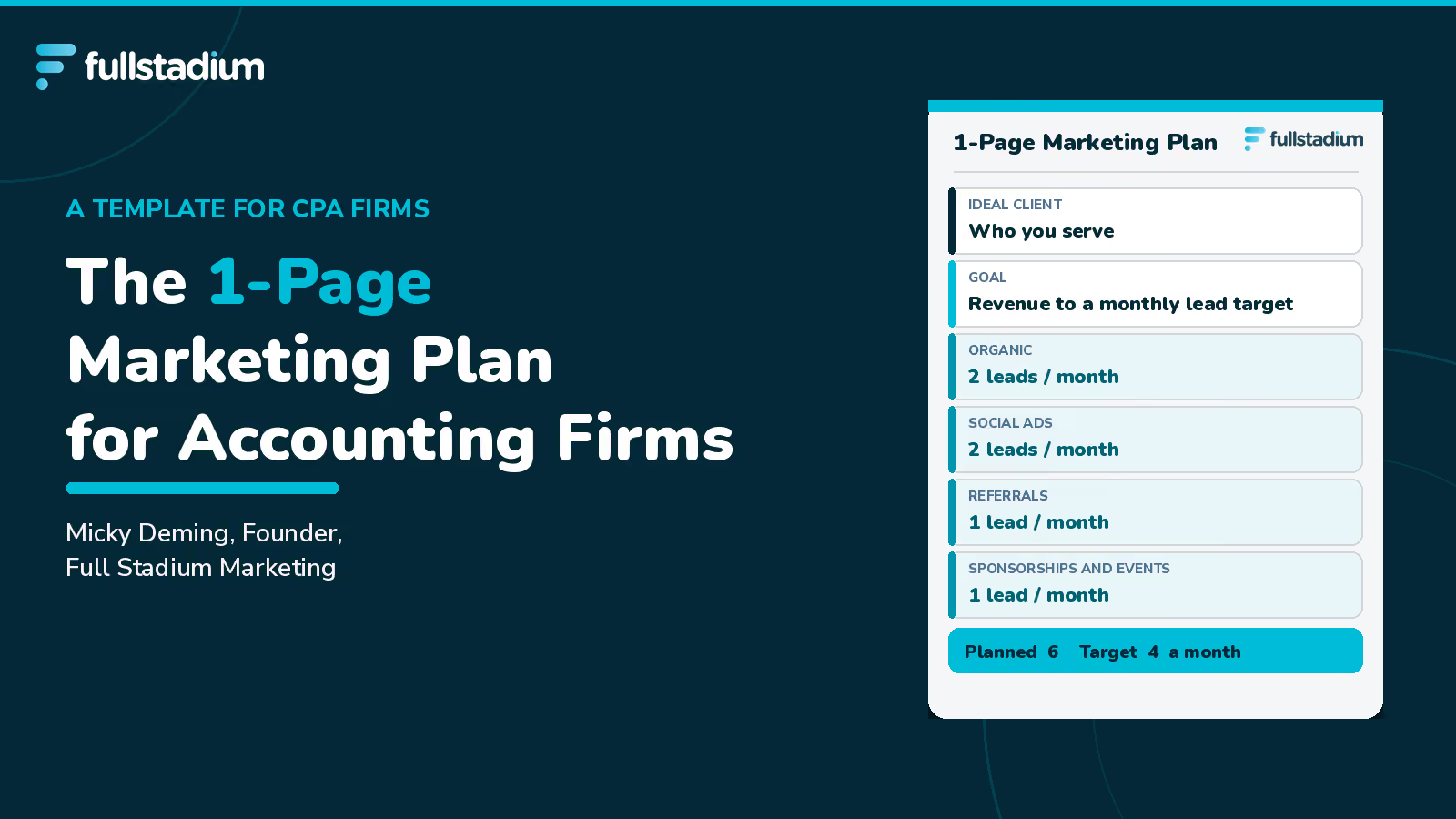
Each channel gets actions to complete every month and a leads goal. Here's an oversimplified example: 2 leads a month from organic, 2 from ads, 1 from referrals and 1 from sponsorships and events.
That's 6 a month, which puts you over the target of 4.

That cushion matters. If your close rate drops from one in three to one in four as you bring in colder leads, you'd need 60 leads for the year, or 5 a month, and you're still covered.
Step 4: Plan for the ramp
These channels don't all start at full speed in January. Referrals and events can produce leads in the first month. Ads work best once you know which message lands, and they still take a couple of months to tune. Organic search usually takes six to twelve months before it brings in steady leads.
So lean on the fast channels early and let the slow ones build. A realistic year might look like this:
That adds up to about 63 leads for the year. It covers the 45 you need, and it still covers the 60 you'd need at a one-in-four close rate. It also tells you what to expect, so a quiet first quarter from organic reads as the plan working on schedule.

What the finished page looks like
Here's a simple version of the page.
Ideal client: Personal injury law firms with 5 to 20 attorneys that run on Clio.
Goal: Grow from $80,000 a month to $100,000 a month by year-end. Expected churn: $10,000 a month. New monthly revenue to add: $30,000. Average client: $2,000 a month. New clients needed: 15. Close rate: 1 in 3. Qualified leads needed: 45 for the year, about 4 per month. Planned: 4 a month in Q1, 5 in Q2, 6 from Q3 on (about 63 for the year).

That's it. One line on who you serve, one goal, a few channels, who owns them, how often things happen and what you expect from each.
This is where the plan pays off. You're playing offense instead of waiting and hoping for the next referral. And if results lag, you'll see it early enough to adjust.
How to follow through on the plan
The page is the easy part. Following through is where most plans live or die.

Give every channel one owner, and ideally not the firm owner. If every channel runs through you, you're the bottleneck, and marketing stops every time client work gets busy. One name per channel, and it's that person's job to make sure the monthly actions happen. That person can be a coordinator, an operations manager or an agency that specializes in accounting firm marketing.
Set a cadence and build a 90-day content calendar. "Post regularly" leaves too much open. "Two posts a week, an article the first Tuesday of the month and a newsletter the third Thursday" tells everyone what happens and when. A 90-day calendar keeps you far enough ahead that a busy week doesn't knock everything off track. If you need a starting point for what goes on it, here's what to publish every month.
Remove yourself from publishing. Your expertise is the most valuable part of your content, so you should still be in it. But your role should be to talk or record, and someone else should produce and publish. A 20-minute conversation or a recorded call can become a month of posts, an article and a newsletter without you touching a single editing tool or scheduler. This one change is often the difference between a dormant YouTube channel and a consistent one.
Review a monthly scorecard and adjust quarterly. Once a month, look at two things for each channel: did the actions get done, and how many leads did it produce? Then once a quarter, step back and adjust. For what's working, do more of it. For what isn't, fix it or stop it.
Treat it like a budget variance review. You already know how to do this. Compare plan to actual every month. If organic was supposed to bring 2 leads and brought 0, ask why. Were the actions done? If not, that's an execution problem. If they were done and it still didn't work, that's a channel problem. Either way, you learn something, and you learn it in February instead of December.
Don't quit after one bad quarter. This is the one I'd underline. Focus on the actions, and give the outcomes time. Most of these channels take time to build. SEO compounds. Ads get better as you learn what your audience responds to. Referral relationships deepen with every touch point. That's why the ramp is built into the plan from the start. Each channel becomes better and more predictable with time and consistency, so give it a fair run before you make a call.
The point
Goals are a filter for your actions. When you clarify them, you cut through a lot of noise and waste. Everything becomes intentional, and everything has a purpose.
Skip the 30-page plan. A clear line on who you serve, a number, a few channels, someone who owns each one and the habit of checking in every month will take you further.
If you'd like a copy of the 1-page plan we use with our clients, or you want to walk through your own numbers together, that's what the strategy meeting is for.

Micky Deming shares insights on marketing, growth, and storytelling for accounting firms. Explore his expertise and practical strategies on the Full Stadium blog.
Frequently asked questions
One line on who you serve, a revenue goal turned into a monthly lead target, three or four channels with monthly actions and a lead goal for each, an owner for every channel, and a monthly check of plan against actual. If it runs longer than a page, it probably won't get used.
Work backward from your goal. Add the revenue you expect to lose to churn, divide by your average client size to get new clients needed, then divide by your close rate. A firm adding $30,000 a month at $2,000 per client and a one-in-three close rate needs 45 qualified leads a year, or about 4 a month.
Most firms close somewhere between 25% and 50% of qualified consultations. Referred leads close at the high end because they already trust you. Expect the rate to drop as more leads come from ads and search, and build that into your lead target.
It depends on the channel. Referrals and events can produce leads in the first month. Ads usually need a couple of months of testing. Organic search and content take six to twelve months before they bring in steady leads, which is why most firms that quit at month four never see results.
One named person per channel, and ideally someone other than the firm owner. The owner's expertise should stay in the content through recorded conversations, while a coordinator, operations manager or agency handles production, publishing and follow-up.
Related posts

Accounting Firm Marketing Plan: What to Publish Every Month

Client Stories as Proof

How Accounting Firms Can Use AI in Marketing Without Sounding Like Everyone Else